Kū i ka Welo

Fits into the family behavior pattern.
Whether good or bad, one’s behavior is judged by the family he belongs to.

Think about it for a minute. True, right? There are certain family traits that one would expect all offspring to emanate. Can you think of a family like this? When we think famous, perhaps the Kennedy family come to mind. Or Kardashians? How about locally? And within your own circle/neighborhood?

When kids/teens exhibit certain behavior, whether good or bad, it is usually attributed to the parents or even the grandparents of the family. And when it goes against the “welo” it is a bit shocking. “Wow, that’s not how he was raised” or “that is a resilient kid, considering his upbringing”. We hear things like that. Welo is that type of word — those things passed on generation to generation, a heritage kind of thing. You might hear “Welo ʻohana” – as a family trait. “That’s his welo ʻohana”.

What is your welo ʻohana? What are those traits that your ʻohana emanates? Quiet but effective? Loud? Hard workers? A little quirky? Talkative? It is always something to ponder.

Posted in Uncategorized | Leave a comment

Haʻikū

1. n. The kāhili flower (Grevillea banksii), so named because first planted near the town of Haʻi-kū, Maui. (Neal 321.) Also kāhili, and ʻoka pua ʻulaʻula on Niʻihau

2. vs. Haughty, conceited. Rare.

Land division and point, Honomū qd., Hawaiʻi. Land section, Līhuʻe district, Kauaʻi. Quadrangle, land section, village, elementary school, park, reservoir, ditch, East Maui. Valley, Kāne-ʻohe qd., Oʻahu. Lit., speak abruptly or sharp break.

You won’t believe the inspiration for today’s He Momi. If you are on Facebook, and you are a Merrie Monarch week fan, then maybe you won’t be surprised. Long story short, there is a FB page called Merrie Haiku where group members post haiku all Merrie Monarch week long. Yup. Life is short. Live it up. 5-7-5 all week long, from morning to night. People live for this stuff. Trust me.

There are several places in our islands (Hawaiʻi, Kauaʻi, Maui, Oʻahu) pronounced by many as Haiku but trust me, those places were not named after a form of poetry. The correct pronunciation is: hah – ʻee – coo (like the sound from a dove coo). Haʻikū, besides being a place name, also means haughty or conceited. Much like hoʻokano.

So two things you gain from today’s He Momi – the real pronunciation of the places, Haʻikū, and a chance to join a fun Facebook page to compose haiku during Merrie Monarch week. Go take a look!

Posted in Uncategorized | Leave a comment

Oli

nvt. Chant that was not danced to, especially with prolonged phrases chanted in one breath, often with a trill (ʻiʻi) at the end of each phrase; to chant thus. Ke oli, the chant. Mea oli, chanter. (PNP oli.).

Welcome to Merrie Monarch week in beautiful Hilo, Hawaiʻi. Lots going on in this quaint little town: hula, shopping, parade, shopping, eating, shopping, and more hula.   So I thought this an appropriate time to brush up on one important word pertinent to the week.

If you’re going to watch the Merrie Monarch on television (or one of the few who get to view it in person), you will certainly hear a lot of oli. Notice no ʻokina. Oli is chanting that is NOT accompanied by hula. If there is hula involved, then it is mele. When the dancer(s) first go onto the stage the performance will probably begin with an oli, probably a n oli of welcome or something to do with the dance that will follow.

There are many different types or styles of oli, as you have probably noticed. Some of these include: kepakepa (fast, rhythmic chant), hoʻāeae (chant with lengthened vowels), or kēwele (similar but slower than kepakepa). There are more.

Oli (chant) is NOT to be confused with ʻoli (note the ʻokina) which means joyful or happy as in hauʻoli—happy, or nū ʻoli—good news.

Hoihoi nā oli ma ka hoʻokūkū hula – The chants at the hula competition are interesting.

Lōʻihi kekahi mau oli – Some chants are long.

Ikaika ka leo o nāmea oli – the chanters have strong voices.

Tonight is the Miss Aloha Hula competition and each wahine competing will be doing an oli during the kahiko portion. See if you can identify the type of oli!

Posted in Uncategorized | Leave a comment

Kupulau

Welcome to kupulau!  Spring is upon us. Daylight savings time. We sprung forward with adjust our counting for those states whose times change. I like it that we in Hawaiʻi don’t change our time based on the seasons. What’s an hour either way, anyways? Who is fooling who?

When we were in elementary school, we learned that there are four seasons:

kupulau – spring (literally, sprouting leaves)

kauwela – summer (literally, hot season)

hāʻulelau – fall (literally, falling leaves)

hoʻoilo – winter

But, of course, anyone in Hawaiʻi knows that we don’t experience such distinct seasons as someone living in Pennsylvania.  We don’t watch the leaves change colors and fall in Autumn, and we don’t shovel snow from our walkways before work in the winter.  Basically, we don’t have four seasons in Hawaiʻi.

Hawaiians recognize two seasons:  Kau and Hoʻoilo.  Kau is the hot season, when the sun is directly overhead and days are long.  Hoʻoilo is the season when the sun declines towards the south and nights are long (and cold!).  There are six months in each.  These two seasons may vary in start/end time from island to island so this is all a generalized explanation.  In fact, according to Hawaiian historian, David Malo, Molokaʻi has three seasons, Makaliʻi, Kau and Hoʻoilo (that’s why I love Molokaʻi, always different!).

Though we cannot count on leaves changing color or making angels in the snow in our front yards in Hawaiʻi, there are certain other natural phenomena we look forward to during kau and hoʻoilo.  Let me name a few:  whales showing up, and kōlea, too, big surf and sand shifting in hoʻoilo, mangoes, lychee, calm waters, and Merrie Monarch (Haha!) in kau.

Now it’s your turn.  Comment below with things that happen here in Hawaiʻi that we can count on in kau (summer months) and hoʻoilo (winter months) and don’t forget to let me know which season it happens in!

LANGUAGE LESSON

Ua hiki mai ke kau kupulau – Spring season has arrived.

ʻO kēia ke kau kupulau – This is the Spring season.

Posted in Uncategorized | 2 Comments

Huakaʻi

nvi. Trip, voyage, journey, mission, procession, parade; to travel, parade. 

Guess what? Sing it with me: “I’m leavin’, on a jet plane, don’t know when…” Ah, but I do. I will be back in a week.

I am going on a huakaʻi. E huakaʻi ana au. Heading to the land of the long white cloud. Aotearoa. Known by the Pakeha as New Zealand. Yup. Don’t be jealous. It is in my destiny to be a traveler. My father’s Hawaiian name was Kahuakaʻi – The voyager. The traveler. And so I must continue in the tradition of my makua kāne. Heck, continuing on in the tradition of MY PEOPLE! WE ARE VOYAGERS! WE SAIL THE VASTNESS OF THE OPEN OCEAN! And have from the beginning of time. It is in my genes to want to explore, go on journeys. I have always said I am a missionary. Of the going on a mission of exploration to learn more missionary group.

Hele on status coming up.

See  you in another week or so!


Posted in Uncategorized | Leave a comment

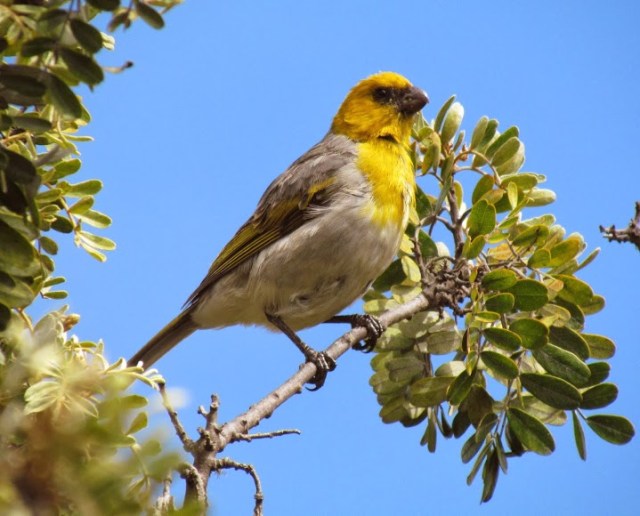
Palila

n. An endangered gray, yellow, and white Hawaiian honey creeper (Psittirostra bailleui, P. kona); endemic to the island of Hawaiʻi. Its bill is especially suited for opening māmane tree pods. Its only home is on Mauna Kea, Hawaiʻi. See ex., olokē, piʻoloke.

The palila is one of my favorite birds for a few reasons.  First of all it is endemic to the island of Hawai‘i, which means you won’t find it anywhere else.  Only on my island.  Secondly, it feeds on the pods of the māmane tree, one of my favorite trees, found in the upper forest regions on the slopes of Mauna Kea, from 6,000-9,000 feet level.  Its bill is especially suited for feeding on these pods, so unlike most other honeycreepers, whose beaks are long and curved, the palila’s beak is short and rather sturdy looking.

Although it feeds mostly on the immature māmane pods, it also eats the māmane flowers, young leaves, as well as insects and naio berries.

Palila is one of the endangered species that is being bred in captivity in hopes of increasing the population in the wild.  Attempts have been made to capture them from one area on the slopes of Mauna Kea and release to other areas in order to encourage a larger habitat area only to find that those palila were either attacked by mongoose or they returned to their original habitat.

He manu nani ka palila – The palila is a beautiful bird.

ʻAi ka palila i ka māmane – The palila eats māmane.

Palila-J.-Bauer-IMG_5001a

Copyright: 2015 – Liana Iaea Honda. All rights reserved. All versions of He Momi e Lei ai”, in its entirety, past and present, is the property of L. K. I. Honda. Reproduction and use of any kind other than the sharing of this website is prohibited. Alteration to the original content in any form is prohibited in every and any instance, and use in any other variant is prohibited without written consent of the author. Adress inquiries to: hemomi [at] gmail.com. Definitions and wise sayings are from: Hawaiian Dictionary by Pukui and Elbert, 1986. ʻŌlelo Noʻeau – Hawaiian Proverbs & Poetical Sayings by Mary Kawena Pukui, 1983.

Posted in Uncategorized | Leave a comment

Wiwo ʻole

The opposite of wiwo ‘ole is wiwo: 1. Fearful, bashful, modest, afraid, timid, shy.  The only difference is the ‘ole. It is the same ‘ole that appears in ‘a‘ole for “no”. In other words, when you add the suffix ‘ole, it negates the word. So wiwo means fearful, bashful, modest, afraid, timid, shy, wiwo ‘ole means fearless, bold, courageous.

Yes, this is the same word that appears in the ‘ohana name of Braddah Iz: Kamakawiwo‘ole.

ka – the

maka – face or eyes

   wiwo ‘ole – fearless

In translating most Hawaiian names or phrases, after the determiner or kaʻi  (in this case, “the”) we begin the English translation “backwards”: the fearless eyes or the fearless face.

Hana wiwo ‘ole – bold or brave deed, adventure

mea wiwo ‘ole – adventurer

He kanaka wiwo ‘ole ‘o ia – She is a fearless person

Ua ‘ike ‘ia ka hana wiwo ‘ole – The brave deed was observed

There are other words with similar meanings, such as koa (synonymous with warrior, for their fearlessness) and maka‘u ‘ole (like wiwo, maka‘u means afraid or fearful). Mai maka‘u i ka hana, maka‘u i ka moloä-Don’t fear work, fear laziness.

Posted in Uncategorized | Leave a comment

Palula

n. Cooked sweet-potato leaves.

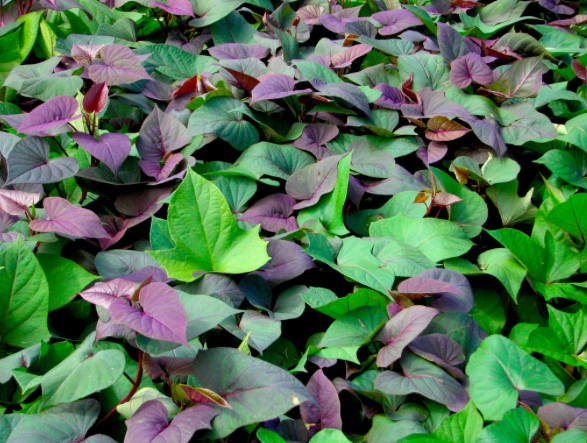
The ʻuala was not just cultivated for its tubers, Hawaiians (and many other cultures) also cook the greens, which is known as palula.  The young leaves are used from all varieties though those with smaller leaves are preferred because of they are considered more flavorful.  In its cooked stage it is known as palula and is quite good.   Palula is a good source of Vitamin E, Niacin and Phosphorus, and a very good source of Vitamin A, Vitamin K, Thiamin, Riboflavin, Vitamin B6, Folate, Magnesium, and Potassium.

Unless you have ‘uala growing in your yard or know someone who does, finding lau ‘uala (sweet potato leaves) may not be easy.  If there is a farmer’s market near you, perhaps you could get some there. I bought lau ‘uala at the farmersʻ market in Hilo.  You can use the lau to make laulau.  Just a pile of washed palula (and the stems are okay, too), a piece of boneless chicken, maybe a piece of fish (we used salmon), perhaps a piece of kalo or ‘uala, more lau, and wrap it all up in lāʻī (ti leaf) and steam.

Palula is not just used as a nutritious food.  In Hawaiʻi, nursing mothers sometimes wore lei of ʻuala vine because the milky sap was thought to kōkua the production of milk for nursing.  There was one variety of ʻuala that was used as bait to attract ʻōpelu.  Different parts of the plant were used as medicine to induce vomiting, to relieve asthma, and act as a laxative.

Just think of the multiple uses out of this one plant that is easy to grow in your own backyard!

Screen Shot 2016-03-09 at 8.00.29 AM

LANGUAGE LESSON

Palula is a noun.

ʻOno ka palula a me ka poi – Palula is ʻono with poi.

Hiki iā kākou ke ÿai i ka palula i kēia lā – We can eat palula today.

ÿÖLELO NO’EAU

ʻŌpū palula – Stomach full of sweet potato greens (said of an ignorant person who can only grow sweet potatoes).

Copyright: 2015 – Liana Iaea Honda. All rights reserved. All versions of He Momi e Lei ai”, in its entirety, past and present, is the property of L. K. I. Honda. Reproduction and use of any kind other than the sharing of this website is prohibited. Alteration to the original content in any form is prohibited in every and any instance, and use in any other variant is prohibited without written consent of the author. Adress inquiries to: hemomi [at] gmail.com. Definitions and wise sayings are from: Hawaiian Dictionary by Pukui and Elbert, 1986. ʻŌlelo Noʻeau – Hawaiian Proverbs & Poetical Sayings by Mary Kawena Pukui, 1983.

Posted in Uncategorized | 1 Comment

Puʻe

1. nvt. Hill, as of sweet potatoes; dune; to hill up. Cf. puʻe one. (PPN puke.)

2. vt. To attack, force, ravish, rape, compel. Keiki puʻe, boy or youth who ravishes women. (Puk. 22.16.) (PPN puke.)

3. n. A lobelia (Lobelia gaudichaudii var. kauaensis) found only in mountains of Kaua’i. The stem, 1 to 2 m high, bears a tuft of narrow leaves 15 cm long, and three or four racemes of large flowers, whitish streaked with purple.

(Okay, friends, think yesterday. Think ʻuala. Remember what ʻuala means? This is a continuation. There is a lot to learn about ʻuala!)

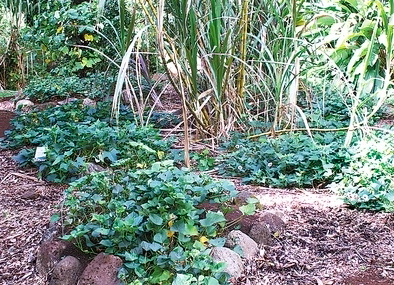
Cultivating ‘uala is not as intensive or time consuming as growing kalo, but there are certain methods that are followed.  Propagation is from cuttings or slips called lau ‘uala.    The slips are planted in mounds called puʻe.  This is the same puʻe that you hear in the song, “Kuʻu Ipo I Ka Heʻe Puʻe One”, my sweetheart surfing [over the] sand bars, by Princess Miriam Likelike.  Two to three cuttings are placed in a hole in each puʻe, then the puʻe are covered with a mulch of leaves to help conserve moisture.  Hawaiians are the best at organic farming techniques!

There are many varieties of ‘uala, although Polynesians brought with them only a few.  Through natural hybridization or cross-pollination other varieties developed whose names were given based on their leaf shapes or colors, skin, and/or colors of the flesh of the roots. An example of this would be the Uahi a Pele (Pele’s smoke) variety whose leaf is a bit dark, resembling smoke, and pia (arrowroot) whose flesh color resembles that of the arrowroot found here.

Interestingly, there is a place on the island of Molokaʻi named ʻUalapuʻe.  Yes! Yesterday’s He Momi and today’s all rolled up into one!  ʻUalapuʻe is located in Kamalō, south Molokaʻi and literally means Hilled Sweet Potato.
Screen Shot 2016-03-10 at 9.27.29 AM

LANGUAGE LESSON

Puʻe is a noun.

Ua hana ‘ia ka puʻe no ke kanu ‘ana i ka ‘uala – The mounds were made for planting ‘uala.

Nui nā puʻe ma ka māla ‘uala – There are a lot of mounds in the ‘uala garden.

‘ÖLELO NO’EAU

Kālina ka pono, ‘a’ohe hua o ka puʻe, aia ka hua i ka lālā – The potato hill is bare of tubers for the plant no longer bears; it is the vines that are now bearing (the mother is no longer bearing, but her children are)

Nā puʻe ‘uala ‘īnaʻi o ke ala loa – The sweet potato mounds that provide for a long journey (said of a patch of ‘uala whose crops are reserved for a journey).

Copyright: 2015 – Liana Iaea Honda. All rights reserved. All versions of He Momi e Lei ai”, in its entirety, past and present, is the property of L. K. I. Honda. Reproduction and use of any kind other than the sharing of this website is prohibited. Alteration to the original content in any form is prohibited in every and any instance, and use in any other variant is prohibited without written consent of the author. Adress inquiries to: hemomi [at] gmail.com. Definitions and wise sayings are from: Hawaiian Dictionary by Pukui and Elbert, 1986. ʻŌlelo Noʻeau – Hawaiian Proverbs & Poetical Sayings by Mary Kawena Pukui, 1983.

Posted in Uncategorized | Leave a comment

ʻUala

‘Uala – sweet potato. Sometimes spelled as ‘uwala (but NEVER pronounced with the hard V sound), this wide-spreading vine was a kinolau, or body form, of Kamapuaʻa, the pig demi god, and dedicated to Lono, god of agriculture.  In fact during the makahiki festival in honor of Lono, ‘gala were laid on the altars of the heiau located in Kealakekua (people believed that Lono had made his first landing in Hawaiʻi here) since it was a staple in that dry area.

Though kalo was, by far, consumed in greater quantities, the ‘uala is more superior nutrition wise.  It was “steamed” in the imu, eaten whole or mashed and mixed with water, similar to poi, although in this form it did not “keep” quite as well as poi kalo. In this way it was considered inferior to its kalo counterpart.  Fermentation was quick.  Sometimes ‘uala was mixed with coconut milk (kōʻelepālau, a delicious dessert and favorite dish in my ʻohana) and eaten thusly or sometimes the raw tuber was grated, mixed with coconut milk then baked in the imu.  The leaves of the ‘uala were also cooked and eaten. I have, in fact, used ‘uala leaves to make laulau, when lūʻau (young taro leaves) were not available.  It cooked faster and tasted ʻono loa!

ʻUala is also used as a medicinal plant.  It is used to induce lactation, and some varieties are said to cure asthma.  It is also used to reduce phlegm (otherwise known as galagala)

‘Uala was cultivated extensively because it would grow in places that kalo would not.  On Ni’ihau, where rainfall is scarce, the people there relied heavily on ‘uala.  It could grow down at sea level, up in the mountains and Hawaiians knew when and where to plant the cuttings depending on the rainfall in the area.  In fact, sometimes when there were times of drought they would grow ‘uala in the lo’i kalo, the taro terraces, when kalo could not be grown.

Screen Shot 2016-03-09 at 8.02.00 AM

LANGUAGE LESSON

‘Ono ka ‘uala – Sweet potato is delicious.

Na wai i ‘ai i ka poi ‘uala? – Who ate sweet potato poi?

‘O ka ‘uala poni ka’u punahele – The purple sweet potato is my favorite.

‘ŌLELO NOʻEAU

He ‘uala ka ‘ai hoʻōla koke i ka wī – The sweet potato is the food that ends famine quickly (the sweet potato is a plant that matures in a few months)

Copyright: 2015 – Liana Iaea Honda. All rights reserved. All versions of He Momi e Lei ai”, in its entirety, past and present, is the property of L. K. I. Honda. Reproduction and use of any kind other than the sharing of this website is prohibited. Alteration to the original content in any form is prohibited in every and any instance, and use in any other variant is prohibited without written consent of the author. Adress inquiries to: hemomi [at] gmail.com. Definitions and wise sayings are from: Hawaiian Dictionary by Pukui and Elbert, 1986. ʻŌlelo Noʻeau – Hawaiian Proverbs & Poetical Sayings by Mary Kawena Pukui, 1983.
Posted in Uncategorized | Leave a comment