ʻAla

1. vs. Fragrant, sweet-smelling, perfumed; fragrance, perfume (preceded by ke). Fig., esteemed chiefly. Mea ʻala, ointment, perfume. Ke ʻala kūpaoa, a strong heady fragrance. Ke ʻala punia, a fragrance so strong that it causes dizziness. Cf. ʻaʻala. hō.ʻala To perfume. (PNP kala.)

Esteemed chiefly. Imagine that. ʻAla not only means sweet smelling. Figuratively (and you know the Hawaiian language is steeped in figurative language so always be on guard) it means esteemed chiefly.

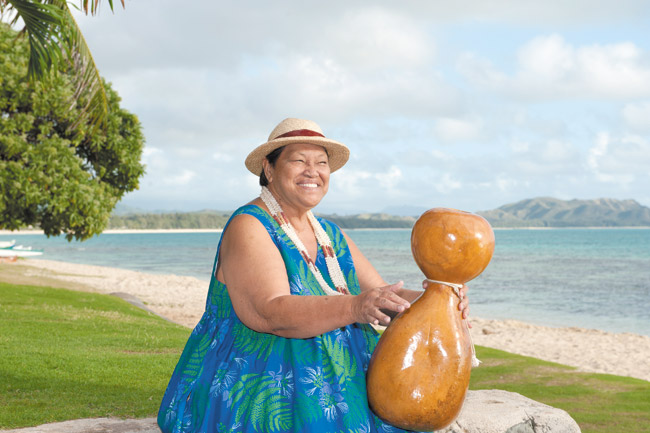
Surely, a good portion of you realize the reason ʻala is today’s word is because yesterday we (a collective we of the world) lost an esteemed chiefly one of the hula realm (and many other realms as well) — Leinaʻala Kalama Heine, affectionately known as ʻAla.

Images that flash through my mind stem back to the days of Brothers Cazimero performances and her hula, so graceful, kolohe at times, refreshing, light, stunning. Bedecked in lei, she was ʻala in all ways. I recall her speaking to students at Kamehameha, a second home of sorts as that was where her hālau (Nā Pualei o Likolehua) practiced each week. Everything she said had mana. And then there was her time on the beach during paddling season. Sitting there on the sand, enjoying her own family and her canoe family, the sun, water. And her times spent as a haumana, always learning and then rallying the hula community to stand up, stand tall, chant, dance for our people, welcome the sun, pay honor to our mauna.

While I could go on. And on. I won’t because it will never be enough.

E lei nō au i ko ʻala – I will wear your fragrance as a lei.

Posted in Uncategorized | 2 Comments

Pōkiʻi

1. Younger brother or sister or closely related younger cousin, often spoken affectionately.  hoʻopōkiʻi –  To claim a pōkiʻi relationship; to behave as a pōkiʻi. (PEP pootiki.)

The word, pōkiʻi, in and of itself, gives a glimpse into the Hawaiian culture.  There is an implied sense of responsibility for older children to watch over, care for, and teach the younger siblings.  In fact, this holds true today in much the same way that it did many many years ago.  Hawaiian children are expected to care for the younger children without being told  and this is not restricted to their own siblings.  This applies to all younger children within the extended ʻohana.

It is understood that the pōkiʻi must listen to the older siblings much like they listen to their own parents.  And if the pōkiʻi does something wrong, frequently it is the older sibling that gets the scoldings.  Many teenagers (and younger) stay home from school to take care of the young ones when the parent(s) cannot do so.  I remember visiting a charter school on Kauaʻi where the older siblings actually brought babies to class and these little ones were accepted into the school.

Kamehameha I uttered a line (well known today) that I take to heart in these trying and frustrating times for Hawaiians:

“I mua e nā pōkiʻi a inu i ka wai ʻawaʻawa. ʻAʻohe hope e hoʻi mai ai.”

Go forward my younger siblings and drink of the bitter waters.  There is no retreating. [Uttered by Kamehameha as he rallied his forces in the battle of ʻĪao]

We, as a people and the pōkiʻi of Kamehameha I, have been drinking of those bitter waters and frankly, I’m tired of it.  I want some sweet water.  But we cannot retreat, we cannot give up.  Our battles are laid out in front of us and we must continue to drink that water, let it quench our thirst, however bitter it may be, and move forward, i mua.

Educate yourself, learn about TMT, Mauna Kea, Haleakalā, Pōhakuloa, Kanaʻiolowalu, take Hawaiian studies classes, get out and volunteer at a loʻi kalo or in our forests or at a school in a Hawaiian community.  We cannot sit idly by, giving the responsibility to others.  We need to take care for our pōkiʻi by getting involved and DOING something, we need to mālama our kuleana, take care of our responsibilities.

Pōkiʻi ka ua, ua i ka lehua – the rain a younger brother, raining on the lehua flowers [the rain and lehua are dear to each other].

I paʻa i ka hānau mua, ʻaʻole e puka nā pōkiʻi – Had het mother died in bearing the oldest, all the others would not have been born [sai in reminding brothers and sisters to respect the hiapo (eldest).]

ʻO ke keiki he loaʻa i ka moe, ʻo ka pōkiʻi ʻaʻole – One can produce a child by sleeping with a mate, but he cannot produce a younger brother or sister. [Great affection between brothers and sisters, and especially for younger siblings, was not rare in olden days. This saying is a reminder to treat younger ones with love and respect.]

Copyright: 2015 – Liana Iaea Honda. All rights reserved. All versions of “He Momi e Lei ai”, in its entirety, past and present, is the property of L. K. I. Honda. Reproduction and use of any kind other than the sharing of this website is prohibited. Alteration to the original content in any form is prohibited in every and any instance, and use in any other variant is prohibited without written consent of the author. Adress inquiries to: hemomi [at] gmail.com. Definitions and wise sayings are from: Hawaiian Dictionary by Pukui and Elbert, 1986. ʻŌlelo Noʻeau – Hawaiian Proverbs & Poetical Sayings by Mary Kawena Pukui, 1983.

Posted in Uncategorized | 2 Comments

Mokulele

n. Airplane, flying ship. Ma ka mokulele, by air.

Let’s take this word apart – moku – ship, district or island. lele – to fly. Flying ship. Or flying island. That kind of says it right? Gives a good visual. And a good insight into how “new” Hawaiian words are developed. In this case, a description of the word is translated into Hawaiian.

Last week I flew from Hilo to PDX (Portland) on the Hawaiian Airlines. You might be able to find a hui mokulele (airline or literally airplane group) with better flight benefits or more room or cheaper fares, but for many reason I love Hawaiian Airlines. Heck, I loved Aloha Airlines, too. There is definitely something about being on a plane with kuene mokulele (flight attendants) who look familiar to me, like I could have gone to school with them (or taught them). They’ve got flowers in their ears, black pearls around their neck, they probably know members of my family or some really good friends of mine. They are part of my home. My moku (island/district).

Yeah they have a monopoly on interisland flights but we all wanted to see the last competitor go (GO! – pun intended). I like to think the best, even in for profit companies. And so while I may not appreciate the prices of flights from one island to another, I do appreciate the fact that so many of my ʻohana members make their living working for this mokulele. And happily so. I see their posts from faraway places, with their fellow kuene mokulele or pailaka (pilots), happy as can be to have a good job that pays their mortgage WHILE benefitting their spouses and circles of friends.

Hawaiian Airlines Airbus A330

E lele ana au ma ka hui mokulele Hawaiian – I am going to fly on Hawaiian Airlines.

Nui ka mokulele – The airplane is big.

Posted in Uncategorized | 2 Comments

Holoholo

1. vi. To go for a walk, ride, or sail; to go out for pleasure, stroll, promenade. Holoholo wale, ride anywhere or aimlessly, stray. He pule holoholo ʻana, a continuous prayer. E holoholo ana ma ka mahina ʻai (Kin. 3.8), walking in the garden. hoʻo.holo.holo To take someone out for a drive or excursion; to escort; to help walk, as a child or invalid. Hoʻoholoholo waʻa (For. 4:161), to sail canoes. (PPN solosolo.)

2. nvt. Basting; to baste, sew. hoʻo.holo.holo Caus/sim.; to make large running stitches. Lopi hoʻoholoholo, basting thread.

3. nvi. A net into which fish run (holoholo) after being frightened; to fish with this net.

4. nvi. An old Hawaiian game of kicking a ball to which feathers were attached; to play this game.

Tomorrow I will travel to the west coast and spend some time with my favorite girls (my daughters and daughter-in-law) in Oregon and Washington. Just a few days. But whenever I tell anyone I am going to the mainland they inevitably ask, “What for?” And my reply is, “Holoholo.” We are just going to cruise. Nothing formal (unless you want to count the Tim McGraw concert we are going to attend…uihā). A strictly pleasure trip. I am a firm believer in the benefits of travel. We are, as the translation says, going to ride anywhere or aimlessly. Holoholo. I am sure our straying will take us along the paths of shopping malls and Trader Joe’s but seriously this is all about holoholo.Go for a walk, ride or sail.

My hellhole partners

My holoholo partners and I in Denmark

I am reminded of two songs I learned to dance in my younger days:

Kāua i ka holoholo kaʻa – You and I going for a car ride.

and

Kāua i ka holoholo i ka pō mahina laʻilaʻi – You and I going for a walk on a beautiful moonlit night.

If you are familiar with fishing practices you also know that if someone asks you where you are going you will never come right out and say “fishing”. The correct response is always “holoholo.” Don’t want to let the fish know you are out to get them. He mau pepeiao ko ka iʻa. Fish have ears! You let it out that you are going fishing then bumby HOKA! You going get…NOTHING! If someone tells you holoholo and you keep bugging them then obviously you didn’t learn the lesson small kid time. So now you are informed. No need get scoldings. You can thank me later.

ʻAʻohe pueo keʻu, ʻaʻohe ʻalae kani, ʻaʻohe ʻūlili holoholo kahaki – No owl hoots, no mudhen cries, no ʻūlili runs on the beach (there is perfect peace).

Keiki holoholo kuāua o Makāwao – The lad of Makāwao who goes about in the rain (said of a native of that place who is not afraid of being wet).

He ʻūlili holoholo kahakai, pā i ke kai nui, hina – A sandpiper running about on the beach, when struck by a big wave, falls (a disparaging remark applied to a weakling who cannot fight).

Now get out and go holoholo somewhere, whether it is just for a stroll, a trip, or an activity that may get something delicious from the ocean onto your plate at home!

Posted in Uncategorized | 4 Comments

Lauahi

1. nvt. To destroy, as by fire or lava flow. Fig., quick, deft (as after lima); greedy, lecherous. See ex., one ʻā, ʻowāhi. 

Still going with the lau theme, I was reminded of a line in the male, Puʻu ʻOniʻoni, a hula dedicated to Pele and traditionally performed using ʻiliʻili. Lauahi Pele i kai o Puna – Pele’s lava flows are “doing their destructive thing” towards the sea of Puna.

You can just imagine the flows heading towards Puna, much like what happened just last year as many families evacuated their homes in the Puna district as lava did, indeed, head seaward. Flows stopped short of causing mass destruction (unless you are a transfer station)  but she sure did create havoc with her massive strength. Lauahi. To destroy, as by fire or lava. Imagine it. And generally, as the lava heads towards a home it is the fire that precedes the lava that usually engulfs the home. Lauahi. To destroy, as by fire or lava.

As I gaze out from Luka to kai this morning in Laupāhoehoe (see the lau?), I see the air thick with vog from Pele and I am wondering if we will see any lauahi action in the near future.

Posted in Uncategorized | Leave a comment

Lauaʻe

  1. n. A fragrant fern (Phymatosorus scolopendria syn. Microsorium scolopendria); when crushed, its fragrance suggests that of maile; famous for its fragrance an Kauaʻi (see lauaʻe 2). Pieces were strung in pandanus lei between the keys. See chant, punia. (Neal 27.)
  1. nvs. Beloved, sweet, of a lover. Ka ipo lauaʻe o Makana, the sweet beloved of Makana [reference to the famous lauaʻe ferns of Makana, Kauaʻi]. hoʻo.lauaʻe To cherish, as a beloved memory. I ka make ʻana o kāna kāne, ua hoʻolauaʻe aʻela ʻo ia i ke aloha, at the death of her husband, she cherished the loving memory.
  1. Same as lauaʻe haole.
  1. vt. To gather together, collect. 
  1. (Cap.) n. Wind, Honopū, Kauaʻi. (Nak. 58.)

I love lauaʻe for many reasons. Sometimes it doesn’t even have to be crushed to smell its sweet fragrance. Even when the rain alights upon it, its scent can be smelled. So sweet. Just like maile. But even just its name: lau aʻe. An upright leaf. It has good kaona (hidden meaning). Lau poetically refers to many or numerous. Aʻe is a directional meaning upwards. So it brings up the connotation of multiplying, growing upwards toward the heavens. If you use it in the context of knowledge you are denoting knowledge to grow forth profusely. See what I mean? Gotta love that.

lauaʻe

lauaʻe

All that great info being said, I am here to inform you that the lauaʻe that we commonly seen growing in our islands is NOT a native plant. I know. It is hard to believe. In fact, it is considered an INVASIVE species by some. As for me, I don’t consider it invasive. I use it in lei making. And its kaona makes it valuable to me.

There is a native lauaʻe (mahalo to Sam Gon of the Nature Conservancy for his kōkua on this) Microsorum spectrum, also known as peʻahi. It, too, has the fragrance of the maile and is the reason the lauaʻe that we know today was given the same name.

Peʻahi

Peʻahi

Copyright: 2015 – Liana Iaea Honda. All rights reserved. All versions of “He Momi e Lei ai”, in its entirety, past and present, is the property of L. K. I. Honda. Reproduction and use of any kind other than the sharing of this website is prohibited. Alteration to the original content in any form is prohibited in every and any instance, and use in any other variant is prohibited without written consent of the author. Adress inquiries to: hemomi [at] gmail.com. Definitions and wise sayings are from: Hawaiian Dictionary by Pukui and Elbert, 1986. ʻŌlelo Noʻeau – Hawaiian Proverbs & Poetical Sayings by Mary Kawena Pukui, 1983.

Posted in Uncategorized | Leave a comment

Laulau

1. nvt. Wrapping, wrapped package; packages of ti leaves or banana leaves containing pork, beef, salted fish, or taro tops, baked in the ground oven, steamed or broiled; any cloth, net, or leaves used as a wrapper or carrier; to wrap or carry in such bundles. Laulau moni (Kin. 42.35), bundle of money. (PPN laulau.)

2. n. Hat rim.

3. vs. Pregnant.

4. n. Paddle blade.

I should make the word of the day SLACKER because I only posted two words last week. This is the point where I give you all of my excuses but it isn’t going to happen. No excuse. Time and energy. Life and laziness. But we are back on track and keeping up with the pau words. No need to change course with some sort of word dealing with hurricanes or winds or storms.

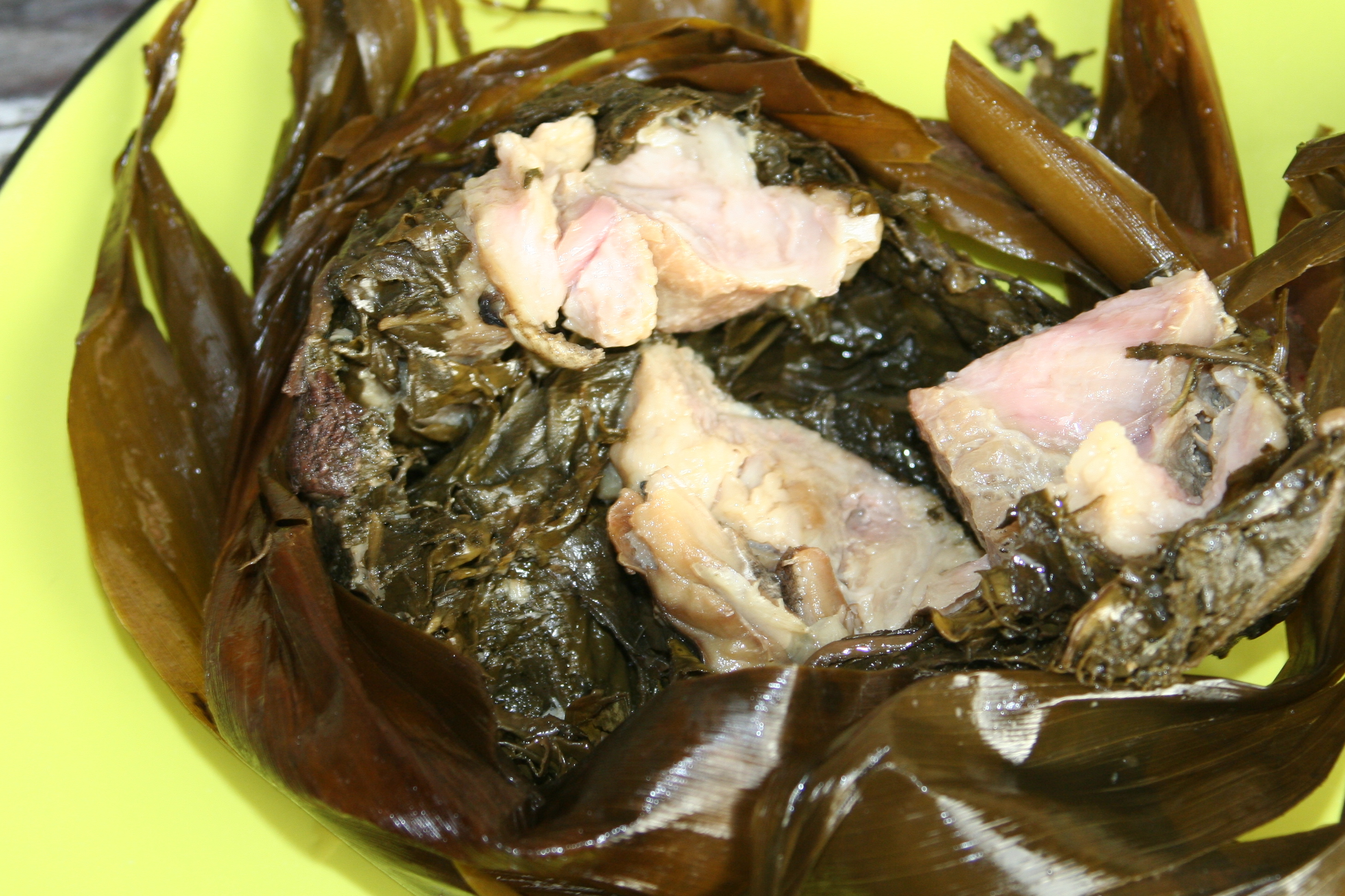
So we all know an ʻono laulau when we see one, right? Laulau refers to a wrapped package but more often it refers to that bundle of ʻono yummy goodness…pork and maybe a piece of fish, perhaps a piece of kalo (taro) or ʻuala (sweet potato) wrapped with several lūʻau (taro leaves) and then held together with two lāʻī (ti leaves). Then steamed for a couple hours until everything just melts together exposing cooked meat and…wait. I am enjoying this too much. And I am getting hungry.

laulau

laulau

Laulau has always been a favorite of mine. I enjoy eating the fatty part of the puaʻa wrapped inside, content to leave the meaty portions for anyone’s taking. I am a lūʻau lover true and true. I love a laulau that has tons of greens in it and I will take anyone else’s lūʻau if they will let me have it.

Laulau also refers to the rim of a hat as well as the blade of a paddle. And in a fun twist of meaning, laulau refers to one who is pregnant. Get it? It is like a woman has a wrapped bundle of goodness growing within. Cute right? Ua laulau – [She] is pregnant. I love saying that when referring to someone who is pregnant. Remember that and try to use it next time. Just like that. Ua laulau.

Posted in Uncategorized | Leave a comment

Lau

4. num. To be much, many; very many, numerous; four hundred. Cf. kini, mano.  hoʻo.lau To make numerous; to assemble, as of numerous persons or animals; numerous. (PPN rau.)

Yesterday we learned about lau, as in leaf. Today, lau refers to a number. No number in particular (although 400 seems to be one of its numbers). The word lau refers to many, numerous. There are several other Hawaiian words that refer to many/numerous, including kini (40,000), mano (4,000), lehu (400,000).

If you are familiar with the word laulima, as in many hands, this is the lau we are talking about.

Here are some other examples:

kinolau – many bodies, referring to the various forms that the gods could take (example: Lono takes the form of kukui or candlenut, a pig, the humuhumunukunukuapuaʻa to name a few).

Ahe lau makani – gentle winds.

Lau a lau nā hōkū o ka lani – hundreds and hundreds of stars in the heaven. 

Lau lena ka pua o ka māmane – the māmane is yellow with blossoms.

Hana a lau a lau ke aho, a laila loaʻa ka iʻa kāpapa o ka moana – Make four hundred times four hundred fish lines before planning to go after the fighting fish of the sea (be well prepared for a big project).

Posted in Uncategorized | Leave a comment

Lau

1. nvi. Leaf, frond, leaflet, greens; to leaf out. Lau is sometimes contracted to lā-, as lāʻī, lāʻie, lāʻō. hoʻo.lau To grow leaves; to leaf out. (PPN lau.)

I so enjoyed last week’s focus on ulu/ʻulu, I thought I would give a shout out to all the lau of the world! And I am not talking about the Chinese Lau (you might have a friend or two with that last name like Beth Maile Lau Wong of Waimea). So let’s try doing a few days of lau.

Lau has two very well known meanings. Today we will focus on lau as in leaf or frond or to leaf out. And you can see in the translation above but a contracted form of lau is , as in lāʻī – ti leaf. Interestingly enough, my favorite beach is a small, relatively unknown cove in Mākaha whose name is Laukīnui – big ti leaf. (note – another well known Hawaiian place names reference book says that Laukīnui is actually Lahilahi Beach. I don’t think so.) Why laukī was used rather than ʻī? Not sure.

You can see it in the place name the shortened term for lau (-) in Lāʻie – leaf of the ʻieʻie. Lāʻie is home of the Mormon Temple and Brigham Young University-Hawaiʻi.

The lauaʻe fern literally means upright (aʻe) leaf. Don’t quote aʻe as being upright. That will take a whole different day to explain. It is a rough translation with aʻe referring to an upward movement.

lauaʻe

lauaʻe

Lauhala, the leaf of the hala, or pandanus, is just that. The leaf. The plant/tree is referred to as  hala or pūhala. The leaf is the lauhala.

lauhala hala tree-003

lauhala, dry and fresh, still on the plant.

Another lau plant used by many practitioners of lāʻau lapaʻau (healing using medicinal herbs) is laukahi, otherwise known as the broad leafed plantain. Laukahi is used for a number of ailments, including boils and diabetes.

laukahi

laukahi

ʻŌlelo Noʻeau

ʻAʻohe lau komo ʻole – Any leaf goes in (said of one who does not care whether food is clean or unclean, as long as it suppresses hunger).

ʻAwapuhi lau pala wale – Ginger leaves yellow quickly (said of a weakling who withers easily, or of anything that passes too soon).

He lau maiʻa pala ka wahine, hou aku nō ʻoe, pōhae – A woman is like a yellowed banana leaf that tears when one pokes at it (a woman does not have the strength of a man).

Posted in Uncategorized | Leave a comment

Ulupō

1.  Dark, or dense as growth.  2.  Sudden sickness or stroke, the sign of which is a rooster crowing at untimely hours; such crowing was also believed to indicate the arrival of visitors or a ship.  3.  A fish said to resemble the päpiopio.

The first translation, above, is related to the ulu we learned a couple days ago.  Ulu means to grow and  refers to darkness or night.  In other words, when you combine the two (ulu+pō) the growth is so dense that it is dark, minimal light penetrating the greenery.  That paints a nice image of a lush forest.  A word fit for a song.  Ulupō.

Now the second translation, the sudden sickness or stroke, the sign of which is a rooster crowing is interesting.  I remember my father telling me a story about a pig squealing which caused his grandmother (on Molokai) to fly off into a rage, swearing incessantly at the pig in an effort to thwart the bad connotation.  But I never heard of a rooster crowing story.  How about any of you out there?

Ulupō ka wao nahele – The forest is dark.

Ua nani i ka ulupō o uka – It was beautiful in the dense growth of the uplands.

Kona, mauna uliuli; Kona mauna ulupō – Kona, of the green mountains; Kona of the dense forest (said in reference to North and South Kona, Hawaiʻi)

Copyright: 2015 – Liana Iaea Honda. All rights reserved. All versions of He Momi e Lei ai”, in its entirety, past and present, is the property of L. K. I. Honda. Reproduction and use of any kind other than the sharing of this website is prohibited. Alteration to the original content in any form is prohibited in every and any instance, and use in any other variant is prohibited without written consent of the author. Adress inquiries to: hemomi [at] gmail.com. Definitions and wise sayings are from: Hawaiian Dictionary by Pukui and Elbert, 1986. ʻŌlelo Noʻeau – Hawaiian Proverbs & Poetical Sayings by Mary Kawena Pukui, 1983.

Posted in Uncategorized | 1 Comment