Lokomaikaʻi

nvs. Good will, good disposition, generosity, grace; kind, humane, gracious, benevolent, beneficent, obliging. Nā lā o ka lokomaikaʻi, days of grace [time allotted for paying a bill].

Yesterday’s word, loko ʻino (bad inside, evil), necessitated an off setting opposite. I don’t want the bad juju around me for more than a day. So today’s “momi” is lokomaikaʻi – good inside, goodness. Some smart, no? Loko – inside. maikaʻi – good. When you are good inside, you surely are gracious, benevolent, kind, full of grace. I bet you know at least a handful of people who fit this description. I am going to say you probably have an overflowing handful of people that you know personally and maybe even a bunch that you don’t know personally but you know because they were/are famous — Mother Theresa. Gandhi. Princess Pauahi.

I do believe, now more than ever, that there are way more people in this world who are lokomaikaʻi rather than loko ʻino. Look around at the person who has no qualms reaching out to the homeless or those in need. Lokomaikaʻi. Think of the people paying it forward in the Starbucks line. Surely that is evidence of lokomaikaʻi. How about those who donate money to their favorite charities. Or pick up the rubbish they see on the ground. All of those acts are acts of lokomaikaʻi. They show the generosity and grace of mankind.

Those who are steadfast in protecting our sacred mauna. Lokomaikaʻi. Not going to work. Sleeping in the freezing cold with no access to the comforts of home. Away from family. Lokomaikaʻi. Whether you agree or not about the #aoletmt movement, know that those who want to protect our ʻāina, are doing it because of the goodness of their insides. They feel and believe so strongly in the sacredness of Maunakea as the piko of Hawaiʻi, as the child of Papa and Wākea, that they will protect her to no end.

How do you show lokomaikaʻi to those who need it most? How do you exhibit lokomaikaʻi to the ʻāina and to the kai? How do you make this space in time and place a better place through your words and actions?

ʻAʻohe lokomaikaʻi nele i ka pānaʻi – No deed has ever lacked a reward (and the best reward is the intrinsic joy of making this world a better place rather than fortune and fame).

He lokomaikaʻi ka manu o Kaiona – The bird of Kaiona is kind (said of one who helps a lost person find his way home).

Make an effort today and everyday to be lokomaikaʻi in a way that is quite different than your usual self. We get comfy in being kind in the same way everyday (smiling to all, giving a hug, greeting with eye contact) but try something different (feed the homeless, buy a meal for someone who needs it, go pick up some litter on the street, donate to a worthy cause).

Copyright: 2015 – Liana Iaea Honda. All rights reserved. All versions of He Momi e Lei ai”, in its entirety, past and present, is the property of L. K. I. Honda. Reproduction and use of any kind other than the sharing of this website is prohibited. Alteration to the original content in any form is prohibited in every and any instance, and use in any other variant is prohibited without written consent of the author. Adress inquiries to: hemomi [at] gmail.com. Definitions and wise sayings are from: Hawaiian Dictionary by Pukui and Elbert, 1986. ʻŌlelo Noʻeau – Hawaiian Proverbs & Poetical Sayings by Mary Kawena Pukui, 1983.

Posted in Uncategorized | Leave a comment

Loko ʻino

Merciless, heartless, evil, malevolent, barbarous, cruel; such a person.

Loko ʻino – two words. First word, loko, refers to the insides. During my small kid time, many a lūʻau served, amongst the usual flair, loko. That’s the insides. I can remember watching my grandma preparing loko. After the men killed the pig and gutted it, prepping it for the imu, my grandma would take everything that was i loko (inside)—the heart, liver, lungs, kidney, everything (almost) — and make the loko. Plenty garlic. The blood. At least that is what I am remembering. Do you remember loko?

ʻIno is everything that is bad, wicked and vicious. It is also the word for storm, for something that is foul and spoiled. It is also translates as to injure, harm, or break. As you can tell it is not a good word.

So put together loko ʻino means “bad insides”. Isn’t that a great description for someone that is that way? Hawaiians know. If you’re evil, your insides must be all foul!

Auē nō hoʻi ē, he kanaka loko ʻino ʻo Likeke – Goodness gracious, Richard is an evil man (no offense to any Richards out there).

He loko ʻino kona – He has bad insides.

Hōʻike ʻia ka loko ʻino o ke kanaka ma o kāna hana – The evil ways of man is known through his deeds.

Copyright: 2015 – Liana Iaea Honda. All rights reserved. All versions of He Momi e Lei ai”, in its entirety, past and present, is the property of L. K. I. Honda. Reproduction and use of any kind other than the sharing of this website is prohibited. Alteration to the original content in any form is prohibited in every and any instance, and use in any other variant is prohibited without written consent of the author. Adress inquiries to: hemomi [at] gmail.com. Definitions and wise sayings are from: Hawaiian Dictionary by Pukui and Elbert, 1986. ʻŌlelo Noʻeau – Hawaiian Proverbs & Poetical Sayings by Mary Kawena Pukui, 1983.
Posted in Uncategorized | Leave a comment

Manaʻoʻiʻo

nvt. Faith, confidence; to have faith, confidence; to believe. Kumu manaʻoʻiʻo, creed. Pelika o ka manaʻoʻiʻo, covenant of faith.

I am just gonna come out and say that this is a post missionary word, it came to life as missionaries needed it when translating the bible. Faith, hope, and love.

Manaʻo – nvt. Thought, idea, belief, opinion, theory, thesis, intention, meaning, suggestion, mind (Mat. 22.37), desire, want; to think, estimate, anticipate, expect.

ʻIʻo – vs. True, genuine, significant, real; really, truly, surely, actually; true worth.

I love the beauty of our Hawaiian words, how they are put together to create a whole new word: Manaʻoʻiʻo – faith. A genuine belief. A true thought.

It isnt even Christmas and this word has come up several times in the past two weeks: Manaʻoʻiʻo. Faith. I have some genuine beliefs but at times I flounder and try to micromanage the outcomes when all I have to do is think of manaʻoʻiʻo. Have faith. Remind me if you see me flounder.

ʻO ka manaʻoʻiʻo, ka manaʻolana a me ke aloha – Faith, hope and love.

He manaʻoʻiʻo koʻu – I have faith.

Copyright: 2015 – Liana Iaea Honda. All rights reserved. All versions of He Momi e Lei ai”, in its entirety, past and present, is the property of L. K. I. Honda. Reproduction and use of any kind other than the sharing of this website is prohibited. Alteration to the original content in any form is prohibited in every and any instance, and use in any other variant is prohibited without written consent of the author. Adress inquiries to: hemomi [at] gmail.com. Definitions and wise sayings are from: Hawaiian Dictionary by Pukui and Elbert, 1986. ʻŌlelo Noʻeau – Hawaiian Proverbs & Poetical Sayings by Mary Kawena Pukui, 1983.

Posted in Uncategorized | Leave a comment

Makua kāne

Father; male parent.

Today, Memorial Day, I honor my makua kāne, my dad, Shermaih Kahuakai Iaea, Jr. Also known as Jerry Boy. Bulla. Sarge. He passed away 7 years ago next month. My mom and my brothers always told me I was my dad’s pet. A spoiled brat, thanks to him. I grateful accept the title. He gifted me with a love for who I am as a Hawaiian, a female, always making me feel like I could accomplish anything.

My makua kāne joined the army while still in high school (when you naughty at KS and they give you the boot, well, options are limited). And remained in the Army until I was a Sophomore in high school. During his military career he served in the Korean War (his brother, Alvin, is MIA from that war) and went to Vietnam twice while I was in school, once in third grade and again in middle school. In his later years, my makua kāne was active in a couple of veteran groups (Veterans of Foreign Wars was one, as I recall). Attending meetings and participating in parades kept him active. I am grateful for that.

Whenever I see military vets in parades (anywhere really), tears come readily to my eyes. A mere commercial or news story of military personnel coming home from faraway places to be with their families again cause a flood of emotions. I am so grateful to all those who join the military services, willing to fight for freedom, no matter what the cost. I am eternally thankful.

Aloha au iā ‘oe, e ku’u makua kāne.


Posted in Uncategorized | 1 Comment

Puka

  1. Hole; door, entrance, gate, slit, vent, opening, issue.  2.  To pass through, appear, emerge, come out; to rise, as the sun. 3.  To graduate. 4.  To say, utter, speak.  5.  To gain, win, profit; to draw interest; winnings, gain, profit. 6. Trap, snare. 7.  idiom.  Almost.

I bet you didn’t realize there were so many meanings for the word puka Puka , second only to pau for frequently used Hawaiian words in daily life (of course I am not counting aloha and mahalo because everyone worldwide uses these words).  Don’t quote that tidbit as official info. I made it up.

If you look at the majority of the translations they are related (now is the time for you to stop reading here and glance up and review the meanings again).  You need to visualize a hole and things being able to emerge from a hole (I like to visualize a blowhole, and water shooting out of it).  Visualize the sun coming out of a hole.  Visualize a graduate reaching for the stars out of the hole.  Visualize what you verbalize emerging from a hole (i.e., your mouth). Visualize the winnings which will “take you out of the hole.” You just have to keep in mind the visual. Those are all puka words.

There is one way that puka is misused. Sometimes what we think of as a puka is actually a lua, a pit. Take for example what we would refer to as a hole in the ground. In English we call it a hole (like a pothole in the road) but in Hawaiian it is not a perforated thing where you can see light at the other end. It is a lua, or a pit of sorts. Much like a toilet. Now that is a definitely a lua. No light at the end of that tunnel.

Puka mai ka lā ma ka hikina – The sun rises in the east (the first line of a mele kaʻi, the mele done when a hālau hula emerges onto the stage)

He puka ko ka lole wāwae – The pants have a hole.

E puka ana ʻo Alapaki i kēia Poʻaono – Alapaki is going to graduate this Saturday.

Puka maila ʻoe, ua kala kahiko i Lehua – Now that you have come, [what we had] has long departed to Lehua (Said to one who comes too late to share what his friends have had)

Puka ka lā, puka pū me ka hana, i ʻike ʻia ka lālā maloʻo me ka lālā maka – When day arrives, work time arrives too, for it is then that dry branches can be distinguished from green ones.

Hoʻomaikaʻi to all the haumana who are going to puka this weekend!

Copyright: 2015 – Liana Iaea Honda. All rights reserved. All versions of He Momi e Lei ai”, in its entirety, past and present, is the property of L. K. I. Honda. Reproduction and use of any kind other than the sharing of this website is prohibited. Alteration to the original content in any form is prohibited in every and any instance, and use in any other variant is prohibited without written consent of the author. Adress inquiries to: hemomi [at] gmail.com. Definitions and wise sayings are from: Hawaiian Dictionary by Pukui and Elbert, 1986. ʻŌlelo Noʻeau – Hawaiian Proverbs & Poetical Sayings by Mary Kawena Pukui, 1983.

Posted in Uncategorized | Leave a comment

Kānalua

nvi. Doubtful, undecided, dubious, uncertain; to doubt, hesitate, distrust; reluctance, doubt, hesitation. Members of the Territorial legislature abstained from voting by saying, “kānalua.rd; hoʻo.kā.nalua To cause doubt. Hoʻokānalu ʻole ʻia ʻo kona ʻoiaʻiʻo, there is no cause to doubt its truth.

So much focus going around about positive Hawaiian values such as:  haʻahaʻa (humility), lōkahi (harmony), aloha (love), kuleana (responsibility), mālama (protect/care for).  I am all for them, but how about we focus on a not so positive attribute for today’s He Momi.

Kānalua is the Hawaiian word for doubtful, that fine line you teeter totter on when you can’t come to a decision you feel pono about (to do what is right).  Or when you aren’t really sure about doing or saying something.  That is kānalua.  Probably the most important part of kānalua is the “lua” part, meaning two (yes, lua also refers to toilet but not in this context).    When you are kānalua there are usually two things pulling back and forth in your thoughts, like a tug of war match, or hukihuki.  A lot of that going on when you are kānalua about something.

Members of the Territorial legislature abstained from voting by saying, “kānalua.”

This He Momi came to mind as I was reading the book, “Life of Pi” by Yann Martel.  Therein was a great quote:

“To choose doubt as a philosophy of life is akin to choosing immobility as a means of transportation.”

Here are some Hawaiian phrases using our He Momi of the day:

Hoʻokānalua ʻole ʻia ʻo kona ʻoiaʻiʻo – there is no cause to doubt its truth.

Mai kānalua o hala ʻē ka Puʻulena – Don’t be unsure lest you lose the opportunity.

Ua kānalua ʻo ia i kāna ipo – She was uncertain about her sweetheart.

Don’t be so kānalua in your own life. Make your choices. Or your choices will be made for you.  As Steve Jobs so eloquently said in his 2005 commencement speech at Stanford, “Have the courage to follow your heart and intuition.”

You got this.

Copyright: 2015 – Liana Iaea Honda. All rights reserved. All versions of He Momi e Lei ai”, in its entirety, past and present, is the property of L. K. I. Honda. Reproduction and use of any kind other than the sharing of this website is prohibited. Alteration to the original content in any form is prohibited in every and any instance, and use in any other variant is prohibited without written consent of the author. Adress inquiries to: hemomi [at] gmail.com. Definitions and wise sayings are from: Hawaiian Dictionary by Pukui and Elbert, 1986. ʻŌlelo Noʻeau – Hawaiian Proverbs & Poetical Sayings by Mary Kawena Pukui, 1983.

Posted in Uncategorized | Leave a comment

ʻAʻaliʻi

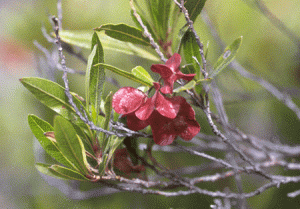
n. Native hardwood shrubs or trees (Dodonaea, all species), 30 cm to 10 m high, more or less sticky at branch tips; leaves narrow, 2 to 10 cm long; flowers small; fruit a yellow, red, or brown papery capsule about 1 cm long and with two to four wings. Fruit clusters are made into leis with their own leaves or ferns and worn in the hair. 

ʻAʻaliʻi is a plant that grows profusely in several areas of Hawaiʻi Island, namely the dry side of Waimea and the upland parts of Waikoloa, Waikiʻi, and, of course, Kaʻū. It is a low growing bush that seems to love high, dry, windy areas. I have seen the plant grow in warmer and wetter areas but not nearly as prolific. Lots of leaves. Minimal color. When it “fruits” the capsules change from light green to a beautiful burgundy that makes wonderful lei and wreaths. It can be quite striking and it dries beautifully.

What many people do not know is that the ʻaʻaliʻi is a symbol of strength and steadfastness in the face of adversity. In fact, the people of Kaʻū are frequently compared to the ʻaʻaliʻi plant, as is stated in this well known ʻōlelo noʻeau:

Heʻaʻaliʻi kū makani mai au, ʻaʻohe makani nāna e kulaʻi – I am a wind-resisting ʻaʻaliʻi, no gale can push me over. (an epithet for the people of Kaʻū)

In other words, I can withstand adversity, I can hold my own in the face of difficulties. Theʻaʻaliʻi plant can survive through the worst of winds, it bends with the force but seldom breaks of falls over, unlike other plants.

There is also this ʻōlelo noʻeau about theʻaʻaliʻi:

He hina na ka ʻaʻaliʻi kū makani, he ʻulaʻa pū me ka lepo – When the wind-resistingʻaʻaliʻi falls, it lifts the sod up with its roots. (This is a boast: When I, a powerful kanaka, fall, others will fall with me.)

Some of our Hawaiian plants stand tall, look beautiful, and are wonderful symbols of great attributes (koa – warrior strength; ʻulu – growth; kukui – enlightenment) but in fierce winds these great trees may topple. Koa forests and many other Hawaiian plants are destroyed by feral animals and cattle. But theʻaʻaliʻi can withstand the prodding of cattle, the droughts of Kona side on Hawaiʻi, and the seemingly never-ending winds.

At times we all need to be like theʻaʻaliʻi. As we face adversity in our jobs, in our personal lives, and all of our other “lives” let us be like theʻaʻaliʻi, and withstand the gale force winds that come our way, in hopes that good weather is right around the corner.aalii

Copyright: 2015 – Liana Iaea Honda. All rights reserved. All versions of He Momi e Lei ai”, in its entirety, past and present, is the property of L. K. I. Honda. Reproduction and use of any kind other than the sharing of this website is prohibited. Alteration to the original content in any form is prohibited in every and any instance, and use in any other variant is prohibited without written consent of the author. Adress inquiries to: hemomi [at] gmail.com. Definitions and wise sayings are from: Hawaiian Dictionary by Pukui and Elbert, 1986. ʻŌlelo Noʻeau – Hawaiian Proverbs & Poetical Sayings by Mary Kawena Pukui, 1983.

Posted in Uncategorized | Leave a comment

Unuhi

vt. To take out, withdraw, as money from a bank, or a drawer from a desk; to unsheath, extract; to take off, as a ring; to translate, interpret. Mea unuhi, translator, interpreter. hoʻo.unuhi To have something translated, withdrawn, etc. (PPN unusi, which is PPN unu + PPN -si.)

It’s been a couple days. Had four wisdom teeth extracted this week and I just wasn’t feeling up to, well, thinking. But I pulled up my boot straps and here I go with today’s “momi”.

Unuhi, to Hawaiian language students, means to translate. You learn it fairly quickly in class because you always want the teacher to translate whatever was said in Hawaiian into English!

I am glad I decided to use unuhi as the word for the day because I didn’t know that unuhi also means to withdraw, as money from the bank. I do that so often now I can put the Hawaiian word to the action! Unuhi also means to extract or unsheath, like taking bullets out of a gun (I actually took that directly from a Hawaiian language newspaper article). Gee. I wonder if it could also be used to extract a tooth! Hmmm…lol.

  • E unuhi ana au i ke kālā mai ka panakō – I am going to withdraw money from the bank.
  • E unuhi mai ʻoe i kou manaʻo – interpret your thoughts to me.
  • Ua unuhi ʻo ia i ka palapala – She translated the document.
  • A laila holo aku la o Davida a unuhi ae la i ka pahikaua nui a Golia mai loko mai o kona wahi, a oki aku la i kona poo – And then David removed the battle knife of Goliath from its place and cut [off] his head.

Copyright: 2015 – Liana Iaea Honda. All rights reserved. All versions of “He Momi e Lei ai”, in its entirety, past and present, is the property of L. K. I. Honda. Reproduction and use of any kind other than the sharing of this website is prohibited. Alteration to the original content in any form is prohibited in every and any instance, and use in any other variant is prohibited without written consent of the author. Adress inquiries to: hemomi [at] gmail.com. Definitions and wise sayings are from: Hawaiian Dictionary by Pukui and Elbert, 1986. ʻŌlelo Noʻeau – Hawaiian Proverbs & Poetical Sayings by Mary Kawena Pukui, 1983.

Posted in Uncategorized | Leave a comment

Ahonui

nvs. Patience; patient, enduring, long suffering; to tolerate. Lit., great breath. Cf. aholoa, pauaho, paupauaho; see ex., lawe 2, makua. Ahonui ʻole, impatient. hoʻāho.nui Caus/sim. E hoʻāhonui aʻe ā pau kēia pilikia, be patient until this trouble is over.   

In our never ending quest to better ourselves, I offer up today’s Hawaiian word: ahonui. Patience. Literally, it means great (nui) breath (aho). You might remember Friday’s word, hoʻomanawanui – to be patient. Hoʻomanawanui literally means to “make the time great”. Same idea with ahonui. Big breath.

Our kupuna know the value of patience. I guess it comes with age. I am waiting for the ahonui ability to kick in. I do find myself taking deep sighs when I am in a trying situation. I am sure it comes across as impatience but I am literally trying to “ahonui”. Take that great breath that will help me to cope with the situation. I guess I shouldn’t make it quite so audible. And now I find my own children doing the same. Oh geez.

The ending of the school year is always a hectic time for me as an educator. This week will be the time to bid aloha to all the keiki and ʻohana that I have been privileged to meet, to get to know, to hug and share stories. I am going to take the time to ahonui. Take that big breath and enjoy those moments in time that make the memories.

Nui kona ahonui – He has a lot of patience.

Ua ahonui nō ʻoe i nā pōpilikia – You have been patient in the times of trouble.

Copyright: 2015 – Liana Iaea Honda. All rights reserved. All versions of He Momi e Lei ai”, in its entirety, past and present, is the property of L. K. I. Honda. Reproduction and use of any kind other than the sharing of this website is prohibited. Alteration to the original content in any form is prohibited in every and any instance, and use in any other variant is prohibited without written consent of the author. Adress inquiries to: hemomi [at] gmail.com. Definitions and wise sayings are from: Hawaiian Dictionary by Pukui and Elbert, 1986. ʻŌlelo Noʻeau – Hawaiian Proverbs & Poetical Sayings by Mary Kawena Pukui, 1983.

Posted in Uncategorized | Leave a comment

Lae

  1. Forehead, brow. 2. Cape, headland, point, promontory. 3. Wisdom; mental or emotional qualities. 4. An insulting term, followed by qualifiers, referring to kauä, outcasts.

Do you know that the original name for Diamond Head is actually Laeʻahi, or Lēʻahi (shortened form) meaning “brow of the ʻahi (yellowfin tuna) fish”. And when you look at an ʻahi and then at Lēʻahi, it looks exactly like that. Too bad its more contemporary name is more prominent today (as one of the most photographed sites in the world). I say we make an attempt to only refer to it by its original name, Lēʻahi/Laeʻahi.

There are other place names with the word lae in it, such as Ka Lae, otherwise known at South Point on Hawaiʻi Island, the southernmost point in all the fifty states. There is also Kalaeloa (the long point), more commonly known as Barbers Point, on Oʻahu. There is Laehala (Hala Point) in Keaukaha, Hawaiʻi, and Kalaemilo (the twirling point) at Kalaupapa, Molokaʻi.

Lae is one of those words whose meanings can contradict each other. On one hand, lae refers to one with wisdom, and on the other hand, it is an insult, making reference to the kauā class, the outcasts whose foreheads were tattooed to distinguish them from the makaʻāinana (commoners) and aliʻi (ruling class).

Some interesting lae words are listed below:

Lae oʻo – an expert (literally: mature brow)

Lae ʻula – A well-trained, clever person (literally: red brow [red being the sacred color]

Lae paʻa – hard headed, obstinate, stubborn, closed in mind and hostile to new ideas (literally: hard brow)

Lae kiko – dotted forehead (kauā ).


Posted in Uncategorized | Leave a comment