Hoʻōla

To save, heal, cure, spare; salvation; healer; savior.

Yes, still focusing on life. Hoʻōla is to cause life. See it in there? Ola. And if you are a He Momi regular, you remember hoʻo– a causative…basically causing the base word’s action (put the word that follows it into action). Because ola starts with a vowel the hoʻo– gets shortened to ho- and the kahakō (macron) then goes on the first vowel of the base word. Sound confusing? Sorry. Just roll with it.

So if ola is life and hoʻo/ho– is a causative, then hoʻōla basically means “to cause life”, as in to save, heal, cure.

He ʻuala ka ʻai hoʻōla koke i ka wī – The sweet potato is the food that ends famine quickly.

While kalo (taro) is the main staple for Hawaiians, the ʻuala (sweet potato) can grow in drier conditions (mahalo to Molokaʻi for all the ʻuala you share in the islands) and can produce in a shorter amount of time (kalo can take upwards of a year or more to mature).

Sending out prayers for healing to those who need it: physically, spiritually and mentally. Ola!

Posted in Uncategorized | Tagged , | Leave a comment

Ola (Part II)

nvs. Life, health, well-being, living, livelihood, means of support, salvation; alive, living; curable, spared, recovered; healed; to live; to spare, save, heal, grant life, survive, thrive. (See Gram. 4.4.) Ola loa, long life, longevity. 

Again, continuing on our theme of LIFE and well-being, we look at another ʻōlelo noʻeau relating to ola.

Aia ke ola i ka waha; aia ka make i ka waha – Life is in the mouth; death is in the mouth. (Spoken words can enliven; spoken words can destroy.)

Another  well known ʻōlelo noʻeau that is very similar:

I ka ʻōlelo ke ola, i ka ʻōlelo ka make – In the word there is life, in the word there is death.

Words have the power to promote well-being and good health and words have the power to “kill”, both literally and metaphorically.

kahuna ʻanā.ʻanā 

n. Sorcerer who practices black magic and counter sorcery, as one who prays a person to death.

Evidence that words can kill. Yes, this is a kahuna who could and would, literally, use words to pray one to death. And I bet there is medical research that shows a WRONG diagnosis for a healthy person ends up having a negative effect on his ola.

Words heal. Words hurt. We know this to be true. Use your words carefully because what you say can make a difference. Use your ʻōlelo, words, to be a positive influence.

Can you think of an example in which the words of someone lifted you up? Or beat you down?

Posted in Uncategorized | Leave a comment

Ola

nvs. Life, health, well-being, living, livelihood, means of support, salvation; alive, living; curable, spared, recovered; healed; to live; to spare, save, heal, grant life, survive, thrive. (See Gram. 4.4.) Ola loa, long life, longevity. 

Life. Health. Well-Being.

Ola is a popular word in Hawaiʻi, used by many businesses and organizations striving for health and well-being. Frequently the word pono is attached – Ola Pono – pono meaning righteous, goodness all that is correct and just. Perhaps a stronger focus on WELL-being. In all ways, inside and out, all four corners of the body (nā kihi ʻehā o ke kino).

Ola nā iwi – The bones live. (Said of a respected elder who is well cared for by his family.)

An elder who is cared for by his ʻohana is one who is not forgotten. His iwi, his bones, live. Iwi is figuratively used to refer to old age. Ola nā iwi goes beyond life though. Bones contain the mana (“divine” power, of sorts) of each individual. In times gone by, the iwi were hidden or watched over lest they get into the hands of the enemy. Iwi must always be protected.

I will spend a few days on this word ola, getting you acquainted with ola as it relates to Hawaiian manaʻo.

Copyright: 2017 – Liana Iaea Honda. All rights reserved. All versions of “He Momi e Lei ai”, in its entirety, past and present, is the property of L. K. I. Honda. Reproduction and use of any kind other than the sharing of this website is prohibited. Alteration to the original content in any form is prohibited in every and any instance, and use in any other variant is prohibited without written consent of the author. Adress inquiries to: hemomi [at] gmail.com. Definitions and wise sayings are from: Hawaiian Dictionary by Pukui and Elbert, 1986. ʻŌlelo Noʻeau – Hawaiian Proverbs & Poetical Sayings by Mary Kawena Pukui, 1983.

Posted in Uncategorized | 6 Comments

Hoʻomākaukau

To prepare, make ready. 

It is a BUSY week for me. School is gearing up. My ʻohana from Denmark will be arriving on Saturday. I have a lot of work to do. I must hoʻomākaukau. PREPARE! Make ready.

If you live here in Hawaiʻi, for some reason, when you hear this being said out loud (because hula class is starting, for instance): “Hoʻomākaukau“, you will typically hear a response of ” ʻAe!”.

Wrong!

Hoʻomākaukau is being confused, many times, with mākaukau – Ready!

I swear, if I am with students, I can say this every single time…hoʻomākaukau (get ready) and inevitably a student (and sometimes an adult) will say: ʻAe (yes). Grrrr. Each time I will tell them, “No. Hoʻomākaukau means to get ready. When you hear me ask ‘Mākaukau?’then you will respond with an ʻae if you are, indeed, ready.”

Simple error. Breathe, Kumu.

Mākaukau means ready. Prepared. Bring it on. I am all set you bet.

Hoʻomākaukau means GET ready. Get in a state of preparedness. If hula is starting make sure you have your pā’ū on and you are in line and your hands are where they are supposed to be. Or if you are in class, your paper and pencil are ready or you are in a state of mind ready to learn. You are mākaukau as in you are all in a state of readiness.

Hoʻomākaukau is what your kumu (teacher) will say to get you in gear. When Kumu says “hoʻomākaukau” what she’s really saying is GET YOUR STUFFS IN GEAR BECAUSE IT IS TIME TO ROCK AND ROLL! And time is awasting. Get it together because we are about to start. Do what you need to do to get in a state of mākaukau-ness. Preparedness.

Do it.

E hoʻomākaukau i ke kaulaʻili – Get the lassos ready.

Ua hoʻomākaukau ʻia ka meaʻai e Māmā – Mom prepared the food.

ʻAʻole i hoʻomākaukau ʻia ka haʻawina o kēia lā – Today’s lesson wasn’t prepared.

Copyright: 2016 – Liana Iaea Honda. All rights reserved. All versions of “He Momi e Lei ai”, in its entirety, past and present, is the property of L. K. I. Honda. Reproduction and use of any kind other than the sharing of this website is prohibited. Alteration to the original content in any form is prohibited in every and any instance, and use in any other variant is prohibited without written consent of the author. Adress inquiries to: hemomi [at] gmail.com. Definitions and wise sayings are from: Hawaiian Dictionary by Pukui and Elbert, 1986. ʻŌlelo Noʻeau – Hawaiian Proverbs & Poetical Sayings by Mary Kawena Pukui, 1983.

Posted in Uncategorized | Leave a comment

Ama

n. Outrigger float; port hull of a double canoe, so called because it replaces the float. Also iama. (PPN hama.)

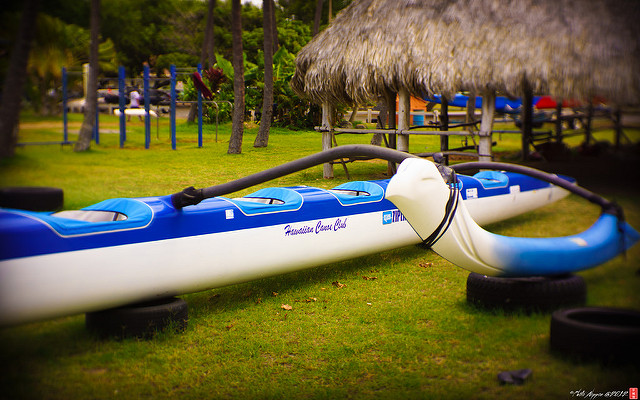
Canoe paddlers know that the ama, attached by the ʻiako, is the outrigger float of the canoe. On a double hull canoe (like the Hōkūleʻa) the port hull (left side) is also known as the ama because it is considered the hull that keeps the waʻa kaulua (double hull canoe) afloat. Check out the parts of a double hull here.

8052587929_91b5222068_z.jpg

In this photo, you can clearly see the ama. As the steersman sits in the last seat on this waʻa (canoe) the ama is on her left side. Without the ama, attached to the canoe by the two ʻiako (the booms), the canoe would not be able to stay upright. Valuable right? Of course, every part of the canoe is valuable but without a good ama made of just the right material, the paddlers and steersman would not be able to go anywhere. Too heavy and moving would be difficult. Too light and the canoe easily flips over.

My inspiration for this post really comes from a valued employee whose “nickname” is Ama, short for Amanda. Like the ama of a canoe, Ama keeps our school afloat, helping balance the daily operations, always striving to do what is best for the keiki. That is what it is always about, right? And like the ama of a canoe, Ama is a vital part of our ʻohana. She keeps our waʻa moving forward.


He mea nui ke ama o ka waʻa – The ama of the canoe is important.

E makaʻala i ke ama – Be watchful of the ama (in a six man canoe it is important for those sitting in seats 2 and 4 to keep an eye out for the ama. If it starts to lift up high out of the ocean, they have to lean towards it, even grabbing onto the ʻiako to prevent the waʻa from a huli (flipping over).

Copyright: 2016 – Liana Iaea Honda. All rights reserved. All versions of “He Momi e Lei ai”, in its entirety, past and present, is the property of L. K. I. Honda. Reproduction and use of any kind other than the sharing of this website is prohibited. Alteration to the original content in any form is prohibited in every and any instance, and use in any other variant is prohibited without written consent of the author. Adress inquiries to: hemomi [at] gmail.com. Definitions and wise sayings are from: Hawaiian Dictionary by Pukui and Elbert, 1986. ʻŌlelo Noʻeau – Hawaiian Proverbs & Poetical Sayings by Mary Kawena Pukui, 1983.

Posted in Uncategorized | Leave a comment

Haʻahaʻa

Redup. of haʻa 1; low, lowly, minimum, humble, degraded, meek, unpretentious, modest, unassuming, unobtrusive; lowness, humility.  hoʻo.haʻa.haʻa To lower, debase, humiliate, humble (Kanl. 8.2), disgrace, underrate, belittle; humble, lowly, modest. Hoʻohaʻahaʻa aku, to condescend. 

Frequently , the values in which we were raised and the values of the “world around us” differ tremendously. Haʻahaʻa is a good example. Haʻahaʻa means to be humble, live your life with humility, do not go around bragging about yourself. Yet, in our jobs and other areas of our lives, we are often asked to toot our own horns, so to speak. Very difficult for many of us. Cultural differences. Opposing values.

In reality, one shouldn’t have to go around bragging about ones’ accomplishments. After all, your good work will become apparent, eventually, in the results of your accomplishments, in how you treat those around you, and how you choose to behave even when you think no one is looking.

When you are haʻahaʻa you don’t need to talk about what you’ve done because others will do it for you without you even knowing it. When you are haʻahaʻa, you definitely don’t hoʻohaʻahaʻa others. Hoʻohaʻahaʻa means that you humiliate someone or are condescending. Hoʻo- to cause. Ouch. Mai hana pēlā. Don’t do that.

ʻO au nō me ka haʻahaʻa – Humbly yours  (use as a closing in your letters)

He kanaka haʻahaʻa nō ʻo ia – He is a humble man.

Haʻahaʻa haka, pau i ka ʻīlio – The contents of a low shelf can be stolen by dogs (Things carelessly left about can be stolen).

Kuʻia ka hele a ka naʻau haʻahaʻa – Hesitant walks the humble hearted (A humble person walks carefully so he will not hurt those about him.

Copyright: 2016 – Liana Iaea Honda. All rights reserved. All versions of “He Momi e Lei ai”, in its entirety, past and present, is the property of L. K. I. Honda. Reproduction and use of any kind other than the sharing of this website is prohibited. Alteration to the original content in any form is prohibited in every and any instance, and use in any other variant is prohibited without written consent of the author. Adress inquiries to: hemomi [at] gmail.com. Definitions and wise sayings are from: Hawaiian Dictionary by Pukui and Elbert, 1986. ʻŌlelo Noʻeau – Hawaiian Proverbs & Poetical Sayings by Mary Kawena Pukui, 1983.


Posted in Uncategorized | Leave a comment

Papa ʻIliʻili

n. Arrangement of pebbles in the form or a man used for instruction by a kahuna hāhā. (Kam. 64:108.)

The training of medical kahuna, or specialists/experts, in Hawaiʻi was quite extensive. You think becoming a physician today is difficult with 8+ years of schooling and then a few more years, perhaps, of internship? Back in the day, kahuna started training as children. Young children. And they specialized in their practices as do many doctors today.

One part of training included a papa ʻiliʻili, which was an arrangement of pebbles in the form of a kanaka (man, human). The papa ʻiliʻili was used to teach the students parts of the body. The pebbles were different colors, shapes, textures. Students had to identify all parts of the body: movable parts, fixed parts, lumps, ridges, everything. Sometimes he had to do this with his eyes closed. You can imagine that a sensitive touch was developed. And that this skill could then transfer over to the human body. Big. Small. Male. Female.

The kahuna who was a master of this is the kahuna hāhā, the kahuna who used palpation or feeling/touching.

So while medical journals, manuals, and textbooks weren’t part of their “official” training, they devised other creative ways to train professionals in the field of medicine, and the papa ʻiliʻili was one of these special means.

Copyright: 2016 – Liana Iaea Honda. All rights reserved. All versions of “He Momi e Lei ai”, in its entirety, past and present, is the property of L. K. I. Honda. Reproduction and use of any kind other than the sharing of this website is prohibited. Alteration to the original content in any form is prohibited in every and any instance, and use in any other variant is prohibited without written consent of the author. Adress inquiries to: hemomi [at] gmail.com. Definitions and wise sayings are from: Hawaiian Dictionary by Pukui and Elbert, 1986. ʻŌlelo Noʻeau – Hawaiian Proverbs & Poetical Sayings by Mary Kawena Pukui, 1983.

Posted in Uncategorized | Leave a comment

Luaʻi

nvi. Vomit; volcanic eruptions; to vomit, retch, erupt; to banish, expel, drive out, as people. (Probably PPN lua, to vomit + -ʻi or -aʻi, transitivizers: Gram. 6.6.4.).

I don’t even want to get into how this word came to mind today. It would be a TMI moment.

I do like this word, luaʻi, because it is so descriptive. Who would have thought to compare a volcanic eruption with vomiting. Got the visual? I wonder. Is it that the volcano is vomiting, or when we get sick and it all comes up, we are erupting?

Contrary to popular belief, to vomit is NOT palu. I hear that frequently from the local community. Someone gets sick, probably from drinking too much. He went PALU! Descriptive enough but it is not the word for vomit. Palu is a chum used by fishermen, particularly when fishing for ʻopelu. Granted, vomit can look like palu, and perhaps serves that purpose for those who get sick on fishing boats, however, the actual act of vomiting is luaʻi.

Luaʻi pō – literally, night vomit. referring to outcasts, as wandering souls not accepted in the realm of the dead.

ʻAi nō ka ʻīlio i kona luaʻi – A dog eats his own vomit. Said of one who says nasty things of others and then has those very things happen to himself. Ouch.

If you or your friends are prone to luaʻi spells on your nights out, help to spread the word – ke luaʻi nei ʻo ia – He is vomiting. Ua luaʻi ʻo Kalā – Kalā vomited. E luaʻi ana ke kāne – The man is going to vomit.

Copyright: 2016 – Liana Iaea Honda. All rights reserved. All versions of “He Momi e Lei ai”, in its entirety, past and present, is the property of L. K. I. Honda. Reproduction and use of any kind other than the sharing of this website is prohibited. Alteration to the original content in any form is prohibited in every and any instance, and use in any other variant is prohibited without written consent of the author. Adress inquiries to: hemomi [at] gmail.com. Definitions and wise sayings are from: Hawaiian Dictionary by Pukui and Elbert, 1986. ʻŌlelo Noʻeau – Hawaiian Proverbs & Poetical Sayings by Mary Kawena Pukui, 1983.

Posted in Uncategorized | Leave a comment

Iʻa

1. Fish or any marine animal.

2. Meat or any flesh food.

3. Any food eaten as a relish with the staple (poi, taro, sweet potato, breadfruit), including meat, vegetable, or even salt. Also ʻīnaʻi. 

4. (Cap.) Milky Way. Ka Iʻa ui o ka lani, the turning Milky Way of the heavens. Ua huli ka Iʻa, the Milky Way has turned [changed position; it is past midnight].

Most people know iʻa to be the general term for fish. Iʻa not only refers to fish, but also the wide array of marine animals in the ocean: eel, oysters, crab, whale (even though we know whales to be mammals it is considered iʻa). Maybe it would be easier to think of iʻa as “sea stuffs”. Limu, or seaweed, is sometimes referred to as iʻa: ka iʻa lauoho lōʻihi o ke kai – the long haired fish of the sea.

Food in Hawaiʻi basically falls into two categories: iʻa for meats or flesh type food and also foods you would eat along with poi; and ʻai – which usually refers to vegetables. Poi, the main staple of Hawaiians, is referred to as ʻai.

Nui nā iʻa o ke kai – There are many types of ocean creatures in the sea.

Here are some ʻōlelo nane – riddles. See if you can guess the answers (below):

  1. Ka iʻa lele me he manu – the fish that flies like a bird
  2. ka iʻa kūehu ōkea – the fish that scatters white sand
  3. ka iʻa moe kahawai – the fish that lies in the stream
  4. ka iʻa mana nui – the fish of many divided parts
  5. ka iʻa maunu ʻole o ke kahawai – the fish of the stream that requires no bait
  6. ka iʻa loloa – the long fish
  7. Ka iʻa kīnohinohi pōhaku – the sea creature that adorns rocks
  8. Ka iʻa lauoho loloa o ke kuahiwi – the long-haired relish of the mountain
(1. malolo, or flying fish; 2. ʻōhiki, or white sand crab; 3. the ʻoʻopu; 4. heʻe, or octopus; 5. wī/hīhīwai; 6. puhi, or eel; 7. pipipi [periwinkle]; 8. greens)

Copyright: 2016 – Liana Iaea Honda. All rights reserved. All versions of “He Momi e Lei ai”, in its entirety, past and present, is the property of L. K. I. Honda. Reproduction and use of any kind other than the sharing of this website is prohibited. Alteration to the original content in any form is prohibited in every and any instance, and use in any other variant is prohibited without written consent of the author. Adress inquiries to: hemomi [at] gmail.com. Definitions and wise sayings are from: Hawaiian Dictionary by Pukui and Elbert, 1986. ʻŌlelo Noʻeau – Hawaiian Proverbs & Poetical Sayings by Mary Kawena Pukui, 1983.

Posted in Uncategorized | Leave a comment

Pāpaʻi

1. General name for crabs. (PPN papa, probably PCP paapaka.)

2. Small temporary hut or shelter.

Pāpaʻi is the general term for crabs in Hawaiʻi, one of my favorite foods. There are many types of crabs, however, each having their own names. I know some of you are thinking of your favorite pāpaʻi right now. There is nothing like Alaskan king crab legs but I will take raw white crab any day!

Remember catching the small white sand crabs during the day? Those are called ʻōhiki.  Then you grab your flashlights and catch the bamboocha ones at night? So fun! Although they are edible we didn’t eat them (though there was always a cousin or dad who would fake it). It was fun just catching them, watching them in the bottom of the bucket and eventually letting them go.

Then there is the ʻaʻama, black delicacies scurrying on the black rocks. Now this is a pāpaʻi that is coveted. Catching them, Hawaiian style, means tying two nīʻau (coconut midribs) in a special way to a bamboo poles, so there is a “v” formation, tying a line across, then snagging the eye of the ʻaʻama. It took skill. Once in a while nowadays you can find people using this method. Otherwise, catching by hand in the night is the way many catch ʻaʻama. Too dangerous for me!

Another ʻono pāpaʻi is the ʻalamihi, another black pāpaʻi (though smaller than the ʻaʻama) and not as easy to find.

The claws of the pāpaʻi are called niho. Yes, niho, the word for tooth or teeth. The claws of the pāpaʻi act as the teeth of the pāpaʻi.

ʻOno ka pāpaʻi – Crab is delicious.

Ka iʻa lamalama i ke one – The fish caught in the sand by torching (the ʻōhiki).

Piʻi mai nei i ka pali me he ʻaʻama lā – Climbs the cliff like an ʻaʻama (said of one who goes beyond his limi).

Hou hewa i ka lua o ka ʻōhiki – [He] poked by mistake into the hole of a sand crab (an expression of derision for a man who marries a very young woman and later realizes it would be better to have a more settled, mature wife).

Copyright: 2016 – Liana Iaea Honda. All rights reserved. All versions of “He Momi e Lei ai”, in its entirety, past and present, is the property of L. K. I. Honda. Reproduction and use of any kind other than the sharing of this website is prohibited. Alteration to the original content in any form is prohibited in every and any instance, and use in any other variant is prohibited without written consent of the author. Adress inquiries to: hemomi [at] gmail.com. Definitions and wise sayings are from: Hawaiian Dictionary by Pukui and Elbert, 1986. ʻŌlelo Noʻeau – Hawaiian Proverbs & Poetical Sayings by Mary Kawena Pukui, 1983.

Posted in Uncategorized | Leave a comment