ʻIhi

1. vs. Sacred, holy, majestic, dignified; treated with reverence or respect. hō.ʻihi

a. To treat thus; to hallow.

b. Tapa or pandanus fitted into a hoop and placed on the head of an attendant (kahu), serving as a holder for a food container from which the chief or favorite child was served, a means of bestowing high honor.

2. n. Wood sorrels (Oxalis, all species), perennial weedy herbs, creeping or not, and bearing cloverlike leaves and yellow, white, red, or pink bell-shaped flowers. The plants have a pleasant sour taste due to oxalic acid. (Neal 473–4.) Known to some as Portulaca spp. (PPN kisi.)

3. See hue wai ʻihi.

I remember Uncle Sol K. Bright (composer of “Hawaiian Cowboy” and “Sophisticated Hula”), whenever he said the pule (and it was always in Hawaiian) he would use the word ʻihiʻihi quite often and his low voice combined with the ʻokina and repetitiveness just made it resound in my mind. Back then (late 80s early 90s…he passed away in 1992) ʻihiʻihi (a reduplication of ʻihi) was a new word to me. I never learned it, never used it. Until I finally looked it up. It meant sacred and holy. So appropriate for a pule. He was exalting the Lord.

Remember hoʻo- the causative? Ho/hō- works the same way. So what do you think hōʻihi means? To cause sacredness. To DO dignity. In other words it means “to respect”.

And I think to myself, what a great way to say respect. When we respect someone we are, in essence, dignifying the person. We are exalting the person. One might counter by saying, but we should only “cause sacredness” to God. I will beg to differ. We should treat everyone with Godliness. To me, each human being is sacred. Some are a bigger challenge to me in that area than others, but nonetheless, each person, big or small deserve hōʻihi. Respect.

When I think about my kupuna, they had/have a lot of hōʻihi for people, always kind and joyful in the face of challenging people. Never raising their voices. Never criticizing others. They just concentrate on their own circle of concern and took care of their own kuleana. That shows respect for others AND respect for self. Hōʻihi. ʻIhi.

ʻIhi ke kua, meha ke alo; ka hua i ka umauma hōʻike ʻia – Sacred is the back, silent the front; the word on the chest, reveal (an expression often used by chiefs. No one stands behind and no one else is here in my presence, so deliver your message to me).

Keauhou i ka ʻihi kapu – Keauhou, where strict kappa were observed (Keauhou Kona. this was the place where many of the highest chiefs resided).

Copyright: 2015 – Liana Iaea Honda. All rights reserved. All versions of He Momi e Lei ai”, in its entirety, past and present, is the property of L. K. I. Honda. Reproduction and use of any kind other than the sharing of this website is prohibited. Alteration to the original content in any form is prohibited in every and any instance, and use in any other variant is prohibited without written consent of the author. Adress inquiries to: hemomi [at] gmail.com. Definitions and wise sayings are from: Hawaiian Dictionary by Pukui and Elbert, 1986. ʻŌlelo Noʻeau – Hawaiian Proverbs & Poetical Sayings by Mary Kawena Pukui, 1983.

Posted in Uncategorized | Leave a comment

Uluhe

n. All Hawaiian species of false staghorn fern (formerly known as Gleichenia spp., now listed under three genera: Dicranopteris, Hicriopteris, Sticherus), weedy, creeping, branching ferns, forming dense thickets. (Neal 9.) Also unuhe. (PPN hulufe.)

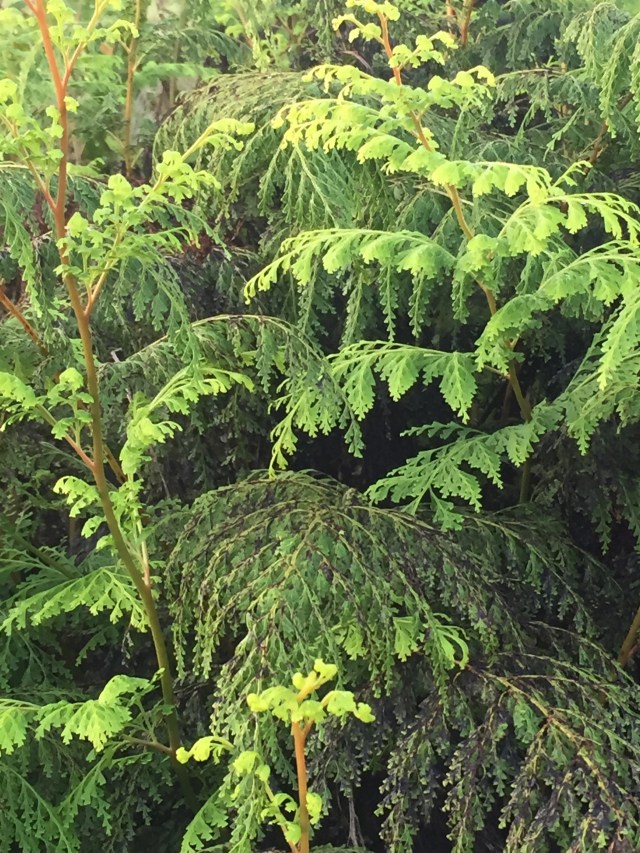
One of the first things I learned about the  uluhe fern is that its goodness lies in its ability to grow so thick in rainforests that invasive species cannot grow. Thank you for that, uluhe. Beautiful and useful. Taking care of the natives. It can grow on fairly barren land. Then as leaves and stems decompose beneath it, the soil becomes richer. More yay for uluhe!

When uluhe grows it is very thick, covering entire sections of mountainsides. If you are on H3 or along the Pali Hwy, you can see it growing alongside the mountain ridges.

The photos above were taken along our mountain road. I am so lucky to be able to have so many different native ferns growing a walk away. I don’t know about using the uluhe in lei for hula. We never did but that doesn’t mean other hālau wouldn’t. Not sure how it would last. It is a very hardy fern.

Pala ulule – Ripened in uluhe fern leaves (A term of derision applied by the shore dwellers of Kaʻū, to the uplands, who were poor farmers. They ripened their bananas in pits lined and covered with uluhe fern leaves, instead of allowing the bananas to ripen in the field).


Posted in Uncategorized | Leave a comment

Palapalai

1. n. Same as palai, a fern.

2. A Niʻihau name for niʻaniʻau and kupukupu.

3. Niʻihau name for gold fern, Pityrogramma calomelanos (syn. P. chrysophylla). (Neal 20.)

While I did say that palaʻā is one of my favorite ferns, palapalai is the most endearing to me. Palapalai reminds me of Kuaokalā, accessed through the  Kaʻena Point Satellite Tracking Station, on the Waiʻanae mountain range. I first went here with my hālau and kumu hula, Mililani Allen, to pick fronds for a hula performance. First sight and I was in love. A romantic affair with a fern ensued. My next encounter was up on Kaʻala, Oʻahu’s highest peak. Fronds longer than my legs. And so green. And feminine, if that is possible. Nothing more beautiful. And now I live just a few miles from a certain area that is uluwehiwehi (lush/verdant) with palapalai. Sorry. Can’t tell you the secret spot lest the nation come and raid. And not everyone knows how to properly gather palapalai. But that is another momi to share with all of you. Long story there.

Palapalai, like palaʻā, is important in hula. Sacred to Laka, goddess of hula, palapalai is used in lei and as an offering on the hula altar. In this year’s Merrie Monarch, many of the dancers performing will most likely be adorned with palapalai as hālau restrict their use of lehua this year due to Rapid ʻŌhiʻa Death.

The photo below is a small palapalai grove that has popped up on the side of a stream bed down the road from my home. It didn’t exist 20 years ago. So refreshing to know that there are areas in our islands where native foliage can just “pop” up rather than being cleared for construction. I suspect it happened as a result of a heavy rainfall that caused this particular stream to flow high and hard, eroding the ʻāina, perfect conditions for fern growth.

IMG_8394

Posted in Uncategorized | 3 Comments

Palaʻā

1. n. The lace fern (Sphenomeris chinensis syn. chusana), a common wild fern in Hawaiʻi; also known in other parts of Polynesia and in Asia. Long, slender stems support smooth, ovate, pointed fronds, about 30 cm long, which are subdivided three times. Formerly a brown dye was extracted from the fronds. Also palapalaʻā and pāʻū-o-Palaʻe. (Neal 15, 16.)

2. n. A tapa of māmaki bark dyed brownish-red with palaʻā fern, of silky quality.

3. vs. Brownish-red.

4. n. Type of stone, used for sinkers for octopus fishing.

Palaʻā, sometimes referred to as lace fern, is one of my favorite ferns for lei making. It is so delicate, yet hardy. It loves to grow in areas that have been disturbed, so it is often one of the first plants to burst forth after a trail has been forged. It is indigenous to Hawaiʻi and can be found throughout the islands but amazingly, you probably won’t find it in your nearest plant nursery! I am guessing it isn’t easy to cultivate. I understand there are places on Oʻahu, on the windward side perhaps, that has an abundance of palaʻā. I have never seen it. In Waiʻanae, where I grew up, we were more apt to find lush patches of palapalai, another fern I will feature this week. I find the main stem of the palaʻā to be much more woody than that of the palapalai.

Palaʻā is important in hula. A companion sent by Pele to accompany Hiʻiaka on her journey was a woman/goddess known as Pāʻū-o-palaʻā (sometimes spelled palaʻe). It is said that Hiʻiaka was able to successfully battle against a moʻo of Puna, wearing a pāʻū (skirt) made of palaʻā. The moʻo became tangled within her pāʻū. For my first ʻuniki (“graduation of sorts) as an ʻōlapa (dancer), I was told to include palaʻā, specially picked on Kauaʻi, in my lei because of the importance it has in hula. Ever since, palaʻā has held an extra special place in my world.

A brown-red dye can be made from the old palaʻā (see #3 above) and I understand it can also be used for medicinal purposes, healing female problems.

IMG_8385

Palaʻā seen on the side of my road.

Posted in Uncategorized | Leave a comment

Kupukupu

1. Redup. of kupu 1; to surge forth, as lava. (For. 6:545.) See ex., unu 2. (PPN tuputupu.)

2. n. General name for ferns on a single stem, such as kupukupu 3. 

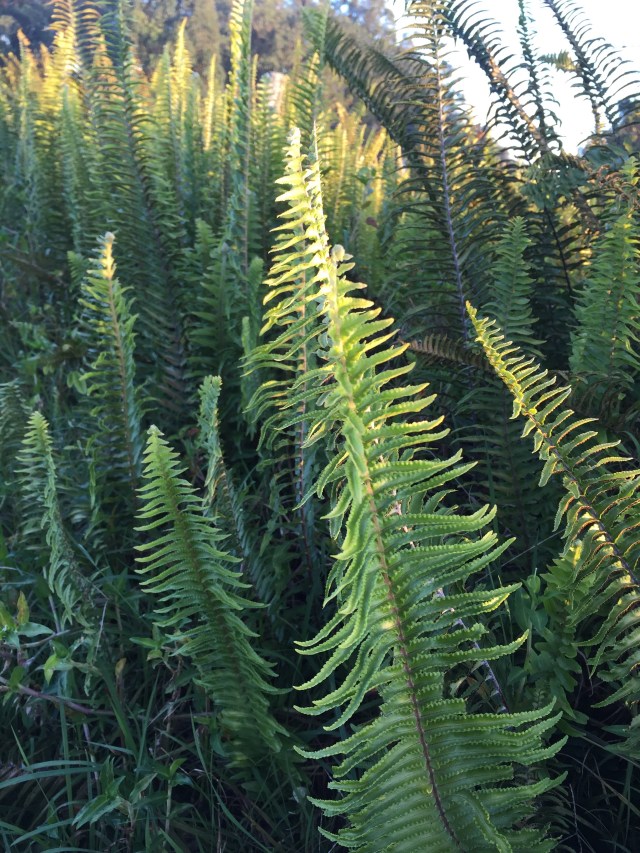
3. n. Sword fern (Nephrolepis exaltata), a long, narrow fern with many lateral divisions. Also niʻaniʻau and palapalai on Niʻihau, and ʻōkupukupu.

One of the more prolific native ferns in our islands, kupukupu can be found in a variety of locations, on all the main islands, from uka to kai. It is, as such, indigenous to the islands.

Kupukupu is the general term for a single stem type fern but it also refers to a specific fern (see photo below). This particular fern is often used in lei or placed on the hula altar to symbolize growth (in knowledge) since the word kupu means to sprout.  Good kaona, this one. If you need inspiration as you seek knowledge (pursuing a degree?), perhaps having a kupukupu plant on your desk might give you much needed assistance.

Kupukupu is many times the first plant to grow from a lava field. It can be purchased as a potted plant but can also just kind of “pop up” from the earth, as it does on my property.


Mohala maikaʻi ke oho o ke kupukupu – Unfolded well are the fronds of the kupukupu (said of a handsome person).

IMG_8399


Posted in Uncategorized | Leave a comment

ʻAʻohe mālama pau i ka ʻiole

No one who takes care of his possessions has ever found them eaten by rats.

When one takes care of his goods he will not suffer losses.

This is an ʻōlelo noʻeau (wise saying) that I first taught my students (little ones and teens). Typically, if you check student desks, whoa. Step back. Papers crumbled, broken pencils. Books from months before. Messes. Usually.

ʻAʻohe mālama pau i ka ʻiole basically means that you should take care of your possessions lest they be eaten up by rats. Want to take a guess why this is my special ʻōlelo noʻeau on this Friday?

You got it. Rat invasion. For the very first time in over 22 years, a rat chewed a hole in our kitchen screen and had a field day on our kitchen counter where I had left out a kalo with full intention to cook it. Apparently the rat wanted to beat me to the punch. Once the crime was discovered, major cleaning commenced. Traps were set. Food put away. Hopefully he just came in, had his fill and left from whence he came. We are on red alert. Not orange. Not yellow. RED.

Hopefully this is the end of this ʻōlelo noʻeau. Learned my lesson.

Posted in Uncategorized | Leave a comment

Mālamalama

1. Redup. of malama 1 (light, month, moon); light of knowledge, clarity of thinking or explanation, enlightenment; shining, radiant, clear. Ka mālamalama o ka ʻākau, northern lights. hoʻo.mā.lama.lama To cause light, brighten, illuminate, enlighten, inform, civilize. (PNP malamalama.)

2. Coris ballieui, a fish; the name may be qualified by the colors ʻula and uli.

3. (Cap.) n. Star name, no data. (Kuhelani.)

I have a new puppy, four months old now, that I need to take outside every night before bed and then back outside every morning, in the wee hours (super wee this morning at 3 am). On the one hand, I am cursing him, calling him a brat as I carry him and shower his head with kisses, having to take him out so early in the morning. The blessing is that I get to look up into the clear dark sky and see the glow of the moon, the sliver that it has been recently (and then none, and then back again), but definitely its distinct mālamalama, illuminating its radiant self to me. As if no one else cares but the mahina (moon). And then back inside I go knowing full well that I can count on that mahina to shine down upon me again when I go outside again. In all its mālamalama glory.

My son’s name has the mālamalama in it. His name translates as the radiancy of the night. He was, indeed, radiant in the night upon his birth.

Let the light shine in your life today. And tonight. And then again the next day.

Ua ao Hawaiʻi, ke ʻōlino nei mālamalama – Hawaiʻi is enlightened, for the brightness of day is here (Hawaiʻi is in an era of education).


Posted in Uncategorized | Leave a comment

Hoʻopaʻa Haʻawina

To study.

Hoʻopaʻa means to “make firm” or “make fast” (recognize that paʻa word in there meaning solid or hard? Same one used in kūkae paʻa – constipation). Haʻawina is the Hawaiian word for lessons, assignment, or task. So when one makes the lesson firm, hoʻopaʻa haʻawina, they must be studying! At least that is the goal of it all, right? To those of you who are taking classes this semester to further your education, e hoʻopaʻa haʻawina me ka maikaʻi – study well! And to Jon all the way in Kenemaka (Denmark) learning how to speak Hawaiian before his big trip this summer – e hoʻomau i ka hoʻopaʻa haʻawina (continue studying).

Pono nā haumāna e hoʻopaʻa haʻawina i nā lā a pau – Students should study everyday.

Maikaʻi ka hoʻopaʻa haʻawina – Studying is good.

Posted in Uncategorized | 3 Comments

Kula

1. n. Plain, field, open country, pasture. An act of 1884 distinguished dry or kula land from wet or taro land. Kō kula kai, shore dweller.

2. n. Source; container. See kula kakalinakula waikula waiwaiKula kālā, source of monetary income. Kula loaʻa, source of profit or gain.

3. n. Basket-like fish trap. Rare.

4. nvi. School, academy; to teach school, go to school; to hold school or class sessions. Eng. Kula ʻia, to be educated in school, sent to school. Specialized schools are usually kula aʻo, as kula aʻo hana lima, manual training school, school of arts and crafts; kula aʻo hīmeni, singing school; kula aʻo hulahula, dancing school; kula aʻo humuhumu, sewing school; kula aʻo kamana, carpenter’s school; kula aʻo kuke, cooking school. Cf. kukula. Kumu kula, school teacher.

5. Also gula nvs. Gold; golden. Eng.

So many meanings to the word kula. Such a small word. Big meanings. We are going to focus on #4 – school, academy; to teach school, go to school. Kula is a transliteration for school. Kula. School. See, when Hawaiians were learning English it was probably hard for them to end words with a hard consonant sound. So blunt. Hawaiian is such a flowing, poetic language. It is even a stretch to put two consonant sounds together such as that sch (sk)  sound. School becomes kula (k for sch sound, u for the oo, keep the l, and add a vowel sound at end). Make sense?

Kula meant other things long before it meant school. There is the plain, field, open country, pasture. There is a source or container. The fish trap. And the all elusive gold (another transliteration, sometimes said as “hula” obviously a post Cook term).

While Hawaiians may not have had official kula in pre Captain Cook days, there was a lot of learning going on, just not in the form of a building with four walls. Children learned the skills necessary to maintain a self sufficient and subsisted lifestyle, some were chosen from very young ages to learn specific skills that they would continue learning throughout their lives (healing, divinity, canoe carving, etc.). Hmmm…maybe we should consider tapping into our kupuna wisdom and rethink what kula should really be.

Posted in Uncategorized | Leave a comment

He manu ke aloha, ʻaʻohe lālā kau ʻole

Love is like a bird — there is no branch that it does not perch upon.

Ah, love is in the air…Valentines is approaching. A fitting ʻōlelo noʻeau to end our week with our fine feathered friends, nā manu.

Love is all around us, and much like the bird that can perch upon each and every branch (and telephone wire, window sill, rain gutter, and porch railing), love can “perch” anywhere.

Of course, manu would hang around on a branch a lot longer if it was strong, sturdy and well protected from the elements that would threaten its well-being. In the same way, when love alights upon us, we must also be strong and sturdy and keep those close to us well protected and secure.

Posted in Uncategorized | Leave a comment